

The U.S. trucking industry operates under strict federal oversight. Regulatory enforcement from the Federal Motor Carrier Safety Administration (FMCSA) and the U.S. Department of Transportation (DOT) is not optional it is mandatory.
Yet many carriers, owner-operators, and fleet managers continue to make preventable compliance mistakes that result in $5,000+ civil penalties, Out-of-Service orders, CDL downgrades, Clearinghouse violations, and even loss of operating authority.
In today's regulatory environment especially with 2024–2025 Clearinghouse enforcement updates non-compliance is more expensive than ever.
This guide outlines five major compliance failures that routinely trigger fines exceeding $5,000 and explains how to proactively avoid them.
1. Failure to Maintain a DOT-Compliant Drug Alcohol Testing Program
Under 49 CFR Part 382, all employers with CDL drivers operating commercial motor vehicles must maintain a compliant DOT drug and alcohol testing program. This is one of the most frequently cited violations during FMCSA audits and one of the most preventable.
Common violations include:
- No random drug testing program see how frequently random drug and alcohol testing is required
- Random testing rates not meeting annual minimums
- No documented drug and alcohol policy
- Failure to conduct pre-employment testing
- No DOT consortium enrollment for owner-operators enroll in a DOT consortium today
Civil penalties for violations frequently exceed $5,000 per occurrence, and repeated violations can escalate significantly.
Additional Risk: Clearinghouse Enforcement (2024 Update)
Since November 18, 2024, state driver licensing agencies are fully integrated with the FMCSA Drug Alcohol Clearinghouse. Drivers with unresolved violations may face:
- CDL downgrade
- Ineligibility for safety-sensitive duties
- Operational disruption for carriers
How to Avoid It
- Enroll in a DOT random testing consortium if you are an owner-operator
- Conduct pre-employment, random, post-accident, reasonable suspicion, and return-to-duty tests as required
- Maintain written policies
- Track annual testing percentages review DOT random testing pool options
- Monitor Clearinghouse queries annually and pre-employment
2. Incomplete or Inaccurate Driver Qualification (DQ) Files
Every motor carrier must maintain a complete Driver Qualification (DQ) file under 49 CFR Part 391. These files document that each driver is legally qualified to operate a commercial motor vehicle. See the full DOT requirements for truck drivers to understand what must be on file.
Common audit failures include:
- Missing motor vehicle records (MVRs)
- No annual MVR review documentation
- Missing medical examiner's certificate
- No employment verification history
- No road test certificate or equivalent
During a DOT safety audit, incomplete DQ files are one of the most frequently cited violations. Fines often start at several thousand dollars per violation and increase with repeat offenses.
Why This Matters More Now
With increased digital audits and compliance reviews, documentation gaps are easier to detect. FMCSA investigators now routinely request electronic submissions before in-person reviews.
How to Avoid It
- Maintain organized digital and physical DQ files
- Conduct annual MVR reviews
- Ensure medical certificates are current
- Use compliance management software to track expiration dates
- Perform quarterly internal audits see how trucking companies can stay DOT compliant
3. Hours-of-Service (HOS) and ELD Violations
Electronic Logging Devices (ELDs) are mandatory for most interstate carriers under 49 CFR Part 395. HOS violations are among the most common roadside citations and audit findings in the industry.
Frequent violations include:
- Log falsification
- Exceeding driving limits
- Failure to use a compliant ELD
- Not retaining HOS records for required periods
- Operating while fatigued
Fines can exceed $5,000 depending on severity, and repeated HOS violations can trigger CSA score increases, compliance reviews, and Out-of-Service orders.
Operational Consequences
Poor HOS management affects:
- Insurance premiums
- Broker relationships
- Safety ratings
- Audit frequency understand what triggers a DOT safety audit
How to Avoid It
- Use FMCSA-approved ELD systems
- Train drivers on proper log entries including recognizing impairment signs that trigger testing obligations
- Monitor logs daily
- Address violations immediately
- Maintain supporting documents for verification
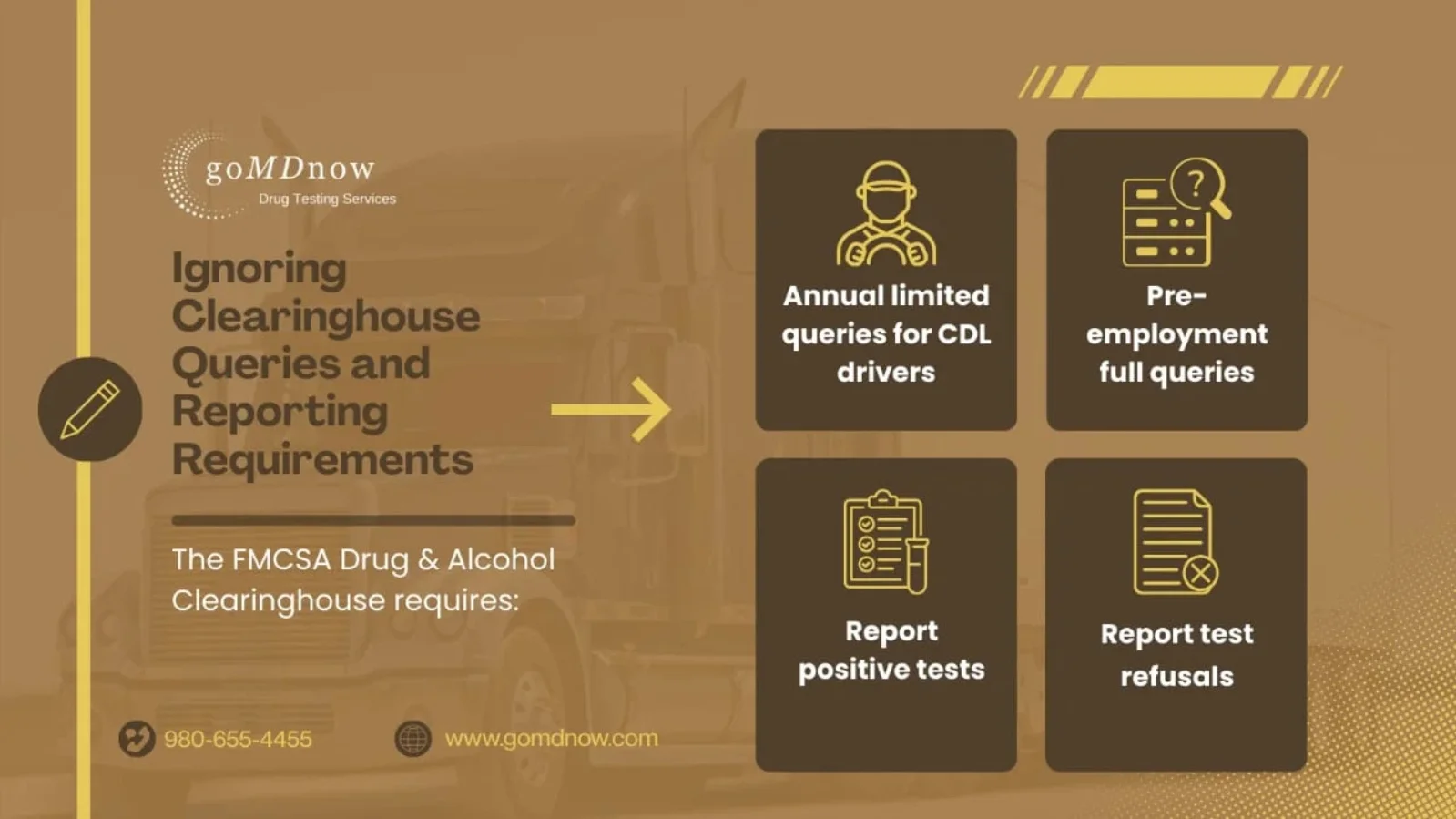
4. Ignoring Clearinghouse Queries and Reporting Requirements
The FMCSA Drug Alcohol Clearinghouse requires employers to:
- Conduct annual limited queries on all CDL drivers
- Run full pre-employment queries before hiring
- Report positive drug and alcohol test results
- Report refusals to test
Failure to conduct required queries or report violations can result in substantial civil penalties and operational liability. Review the most common Clearinghouse violations and how to avoid them.
Major 2024–2025 Risk
If a driver has an unresolved Clearinghouse violation:
- Their CDL may be downgraded
- They cannot legally operate a commercial motor vehicle
- Employers may face penalties for knowingly allowing operation
Allowing a prohibited driver to operate is a serious violation. This is why understanding what qualifies as a DOT violation is critical for every motor carrier.
How to Avoid It
- Schedule annual Clearinghouse limited queries
- Run full queries before hiring part of every pre-employment drug testing process
- Monitor driver status regularly
- Ensure timely reporting of violations
- Document all query consents
5. Operating Without Proper Authority, Insurance, or Updated MCS-150
Operating authority and insurance requirements are enforced strictly by the FMCSA. The MCS-150 is the Motor Carrier Identification Report that all interstate carriers must keep current failure to update it biennially is a direct compliance violation.
Common violations include:
- Expired insurance filings
- Inactive operating authority
- Failure to update MCS-150 biennially
- Misclassification of operations
Penalties may include:
- $5,000+ civil fines
- Immediate Out-of-Service order
- Revocation of authority
- Loss of contracts with brokers and shippers
Compliance Oversight Is Increasing
FMCSA monitors authority status digitally. Brokers routinely verify carrier authority before assigning loads. Non-compliant status can halt operations overnight. This is part of why maintaining active DOT compliance programs across every area of your operation is essential.
How to Avoid It
- Update MCS-150 every two years or when operational changes occur
- Verify insurance filings are active
- Monitor authority status through FMCSA systems
- Conduct internal compliance reviews twice per year
The Financial Impact of Non-Compliance
Beyond fines exceeding $5,000, carriers may face:
- Out-of-Service orders meaning zero revenue generation
- CSA score deterioration affecting safety ratings and audit frequency
- Increased insurance premiums
- Loss of broker relationships
- CDL downgrades triggered by unresolved Clearinghouse violations
- Federal investigations
Compliance is not merely regulatory it is operational risk management. Understand why every carrier needs a qualified TPA or C-TPA to manage this risk effectively.
Building a Proactive Compliance Strategy
To prevent high-dollar penalties, trucking companies should implement:
1. Structured Compliance Management
Assign a compliance officer or outsource to a professional DOT compliance service provider. Having a dedicated point of contact eliminates gaps in documentation and deadline tracking.
2. Regular Internal Audits
Quarterly reviews reduce exposure before FMCSA audits occur. Knowing what FMCSA safety audits examine helps you prepare well in advance.
3. Digital Documentation Systems
Cloud-based compliance systems reduce lost documentation risks. All records DQ files, drug test results, Clearinghouse consents, and HOS logs should be centrally stored and easily retrievable. Understand the chain of custody requirements that apply to drug test documentation specifically.
4. Continuous Driver Training
Educate drivers on HOS rules, drug testing requirements, and reporting obligations. Supervisors should also be trained on reasonable suspicion testing procedures so they can act confidently and correctly when needed.
5. Clearinghouse Monitoring
With CDL downgrade enforcement active since November 2024, monitoring Clearinghouse status is critical. Enroll all drivers, run annual queries, and ensure all violations are properly reported and resolved through the Return-to-Duty process.
Frequently Asked Questions (FAQs)
1. What is the most common reason trucking companies get fined $5,000+?
Failure to maintain a compliant DOT drug and alcohol testing program and incomplete driver qualification files are among the most common violations cited during FMCSA audits.
2. Can a driver's CDL really be downgraded for a Clearinghouse violation?
Yes. Unresolved FMCSA Clearinghouse violations can result in CDL downgrade under current enforcement rules. Since November 18, 2024, state licensing agencies are fully integrated with the Clearinghouse system. Learn more about how Clearinghouse violations lead to CDL downgrades.
3. How can small trucking companies stay compliant?
Enroll in a DOT random testing consortium, maintain organized DQ files, conduct regular audits, monitor Clearinghouse queries, and track all regulatory deadlines. Working with a qualified TPA or C-TPA is the most reliable way for small carriers to manage compliance without a dedicated in-house team.
Final Thoughts
Professional trucking operations require more than trucks and drivers they require disciplined regulatory compliance.
The majority of $5,000+ FMCSA fines stem from preventable administrative failures:
- Poor documentation
- Missed testing deadlines
- Incomplete DQ files
- Ignored Clearinghouse requirements
- Expired authority or insurance
In today's enforcement climate, reactive compliance is no longer sustainable. Proactive systems, documentation control, and regular audits are the only reliable defense against costly penalties.
If your company operates in interstate commerce, compliance is not optional it is operational survival. Contact goMDnow today to build a complete, audit-ready DOT compliance program, or explore our drug testing pricing and nationwide testing network to get started.