
An eCCF device is part of an electronic system used to complete the Federal Drug Testing Custody and Control Form (CCF) during a DOT-regulated drug test. Instead of completing the CCF entirely on paper, a collection site can use an approved electronic system to enter, record, sign, and transmit required testing information digitally.
The eCCF (Electronic Custody and Control Form) connects the key participants in the DOT drug-testing process — the collector, certified laboratory, Medical Review Officer (MRO), employer, and employee — through a compatible, secure electronic workflow. DOT regulations permit the use of an electronic CCF, but it must meet specific federal requirements for confidentiality, security, compatibility, and record handling.
What Does eCCF Stand For?
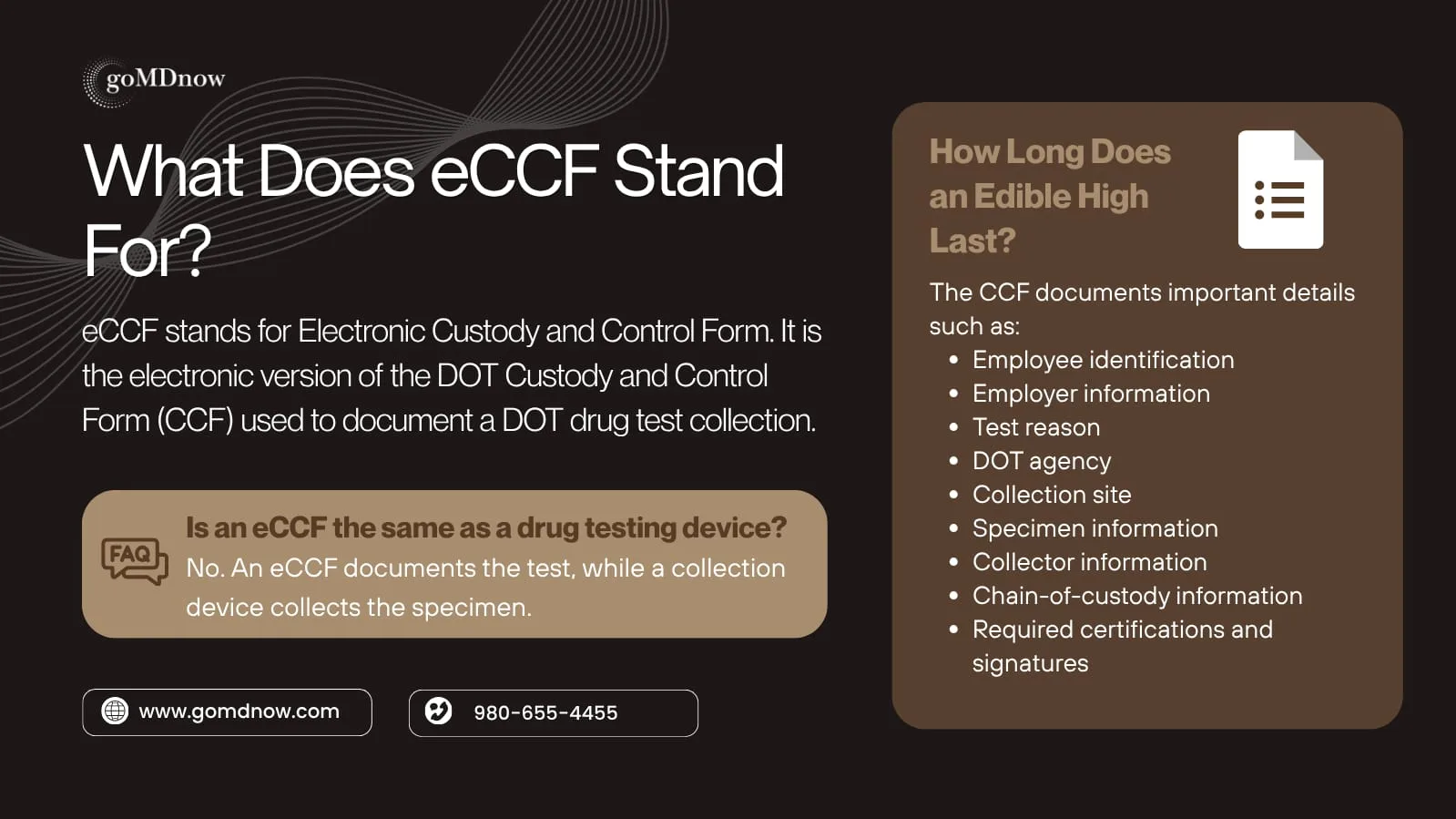
eCCF stands for Electronic Custody and Control Form.
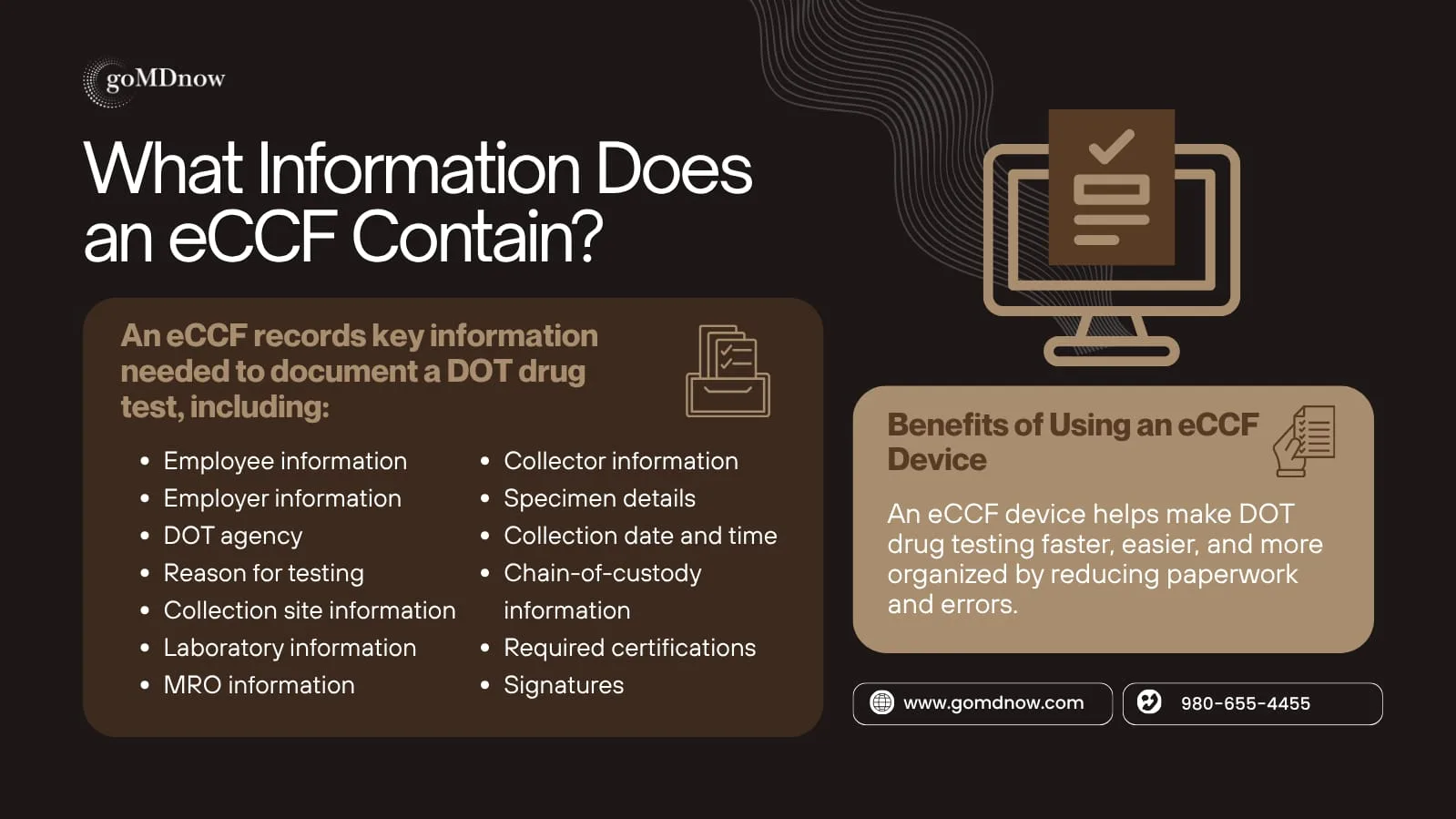
The CCF is the official federal form used to document a DOT drug-test collection. The electronic version performs the same fundamental documentation function as the paper CCF, but information is entered and managed electronically rather than by hand. The CCF — in either paper or electronic format — documents all critical details of the collection, including:
- Employee identification and information
- Employer information
- Reason for testing (pre-employment, random, post-accident, etc.)
- DOT agency governing the test
- Collection site information
- Specimen information and bottle seal data
- Collector information and certifications
- Chain-of-custody documentation
- Required certifications and signatures from both collector and employee
DOT requires the Federal CCF for every DOT drug-test collection. A non-Federal or expired CCF cannot be used for a DOT collection. The revised 2026 Federal CCF became effective on April 27, 2026, and can be used in either paper or electronic format.
What Is an eCCF Device?
An eCCF device generally refers to the electronic equipment used at a collection site to access and complete an approved eCCF system. Depending on the provider and collection site setup, this may be a:
- Tablet or iPad
- Computer workstation
- Touchscreen kiosk
- Another compatible electronic device
However, the device itself is not the eCCF. The device simply provides access to the approved electronic system that creates and manages the electronic CCF. This distinction is important: an ordinary tablet or personal computer cannot automatically be used for DOT eCCF purposes. The electronic system must meet applicable DOT and HHS requirements, and the laboratory involved must have an approved and compatible eCCF system.
How Does the eCCF Process Work? Step by Step
The eCCF process begins when an employee arrives at a collection site for a DOT drug test. Here is how the electronic documentation process flows:
Step 1: Employee and Test Information Is Entered
The collector or authorized user enters the required information into the approved electronic CCF system. This includes:
- Employee name, ID, and required identification
- Employer information and DER contact details
- DOT agency governing the test (FMCSA, FAA, FTA, FRA, PHMSA)
- Reason for testing
- Collection site information
- Laboratory and MRO information
Step 2: The Collector Completes the Collection Procedure
The collector follows all applicable DOT collection procedures under 49 CFR Part 40 while simultaneously using the electronic CCF system to document required information. Critically, the eCCF does not replace the actual specimen collection procedure. The collector still has direct face-to-face contact with the employee during the collection and retains full responsibility for specimen integrity and DOT compliance.
Step 3: Specimen Information Is Recorded
After the specimen is collected, all relevant specimen information — including bottle identification numbers, seal integrity confirmation, and specimen volumes — is recorded in the electronic CCF system. This documentation associates the physical specimen with its chain-of-custody record, which is foundational to DOT compliance. Learn more about the role of DOT chain-of-custody in drug testing.
Step 4: Required Signatures Are Completed
Both the employee and collector complete the required certifications and signatures through the approved eCCF process. Electronic signatures are specifically permitted for the eCCF under the applicable federal rules governing its use — provided the electronic signature system meets DOT security and audit-trail requirements.
Step 5: Information Is Transmitted Electronically
Once collection and documentation are completed, the CCF information moves electronically through compatible systems to all appropriate participants. DOT requires employers using an electronic CCF to ensure that the collection site, primary and split laboratories, and MRO all have compatible systems and that each participant receives a legible copy of the CCF.
eCCF and the Chain of Custody
One of the most critical purposes of the CCF — whether paper or electronic — is documenting the chain of custody. A DOT drug-test specimen must be rigorously tracked and properly identified from collection through final laboratory analysis.
The CCF provides the documentary spine of the chain-of-custody record, including information about every transfer and handling event. With an eCCF system, this documentation is entered and transmitted electronically rather than relying on handwritten entries on a paper form. The electronic process reduces manual data entry errors and makes information easier to transmit securely between authorized participants. However, using an electronic system does not eliminate the obligation to follow DOT collection and specimen-handling requirements in full.
Benefits of Using an eCCF Device
| Benefit | Description |
|---|---|
| Faster Documentation | Electronic entry reduces handwriting and manual paperwork at the collection site |
| Fewer Manual Errors | Required fields and validation features help prevent missing or incomplete information |
| Easier Information Transfer | CCF data moves electronically between compatible laboratory, MRO, and employer systems |
| Better Record Organization | Electronic records make it easier for authorized users to access and manage documentation |
| Improved Workflow | Organizes the documentation process from specimen collection through laboratory processing |
| Reduced Physical Paperwork | Collection sites may reduce their reliance on multi-copy paper CCF forms |
Is an eCCF Device Required for DOT Drug Testing?
No. DOT regulations allow the use of an electronic CCF, but an eCCF is not mandatory simply because a DOT drug test is being performed. A paper CCF can still be used — and must still meet all applicable DOT requirements regarding form version, completion, and handling.
If an employer or service agent chooses to use an eCCF, all applicable requirements must be met. DOT states that an employer using an electronic CCF must ensure that the relevant collection, laboratory, and MRO systems are fully compatible and that legible copies reach all required recipients.
eCCF vs. Paper CCF: Side-by-Side Comparison
| Feature | eCCF (Electronic) | Paper CCF |
|---|---|---|
| Data Entry | Digital input via tablet, computer, or workstation | Handwritten or printed on paper |
| Signatures | Electronic signatures within approved eCCF system | Handwritten wet signatures |
| Information Transfer | Electronic transmission through compatible systems | Physical copies distributed by mail or courier |
| Paperwork Volume | Significantly reduced | Multi-copy paper forms required |
| Error Prevention | System validation and required fields | Relies on human accuracy |
| DOT Authorization | Permitted when all requirements are met | Always permitted (standard method) |
Is an eCCF Device the Same as a Drug Testing Collection Device?
No — these are two completely different things.
- The eCCF device/system is used to complete and manage electronic custody-and-control documentation
- A specimen collection device — such as a urine cup, oral fluid collection swab, or breath alcohol testing device — is used to actually collect the specimen according to applicable DOT procedures
For example, a collector at a urine drug test collection site may use a tablet to complete the eCCF while using a completely separate temperature-strip urine specimen cup to collect the sample. These tools serve distinct and non-interchangeable purposes.
What Employers and CDL Drivers Should Know
Employers and CDL drivers may encounter eCCF systems when completing a DOT drug test at a collection site. Important points to understand:
- For drivers: An electronic form does not change the fundamental purpose or federal requirements of the DOT drug test. The collector still follows the required collection procedure, the specimen is sent to an approved HHS-certified laboratory, and the results follow the applicable DOT process through the MRO.
- For employers: If you elect to use eCCF systems, ensure that your selected collection sites, laboratory, and MRO all have compatible, DOT-compliant electronic systems. Work with a qualified C/TPA to verify system compatibility.
- For all: Seeing a tablet or computer at a collection site does not automatically mean the site is operating an approved DOT eCCF system. Always use authorized testing providers.
Understanding what an eCCF device is and how it works helps drivers, employers, and their C/TPA service agents maintain full compliance with DOT drug-testing documentation requirements. goMDnow partners with HHS-certified laboratories and qualified MROs to ensure every test is properly documented — whether through electronic or paper CCF systems. Schedule a DOT-compliant drug test today or call 980-655-4455.
Frequently Asked Questions
Q. What is an eCCF device?
An eCCF device is an electronic device — such as a tablet or computer — used to access an approved Electronic Custody and Control Form (eCCF) system for DOT drug testing. The device provides access to the electronic system; it is not the CCF itself.
Q. Is eCCF required for DOT drug testing?
No. DOT drug-test collections may use either an approved electronic CCF system or the required paper CCF, subject to applicable rules. If an eCCF is used, the employer must ensure all systems (collection site, laboratory, MRO) are compatible.
Q. Is an eCCF device the same as a drug testing device?
No. An eCCF system documents the chain of custody and collection information, while a specimen collection device is the physical tool used to collect the urine, oral fluid, or other specimen.
Q. Does eCCF replace the required DOT drug test procedures?
No. The eCCF only changes how the required CCF information is documented and managed. All actual DOT collection, specimen-handling, laboratory testing, and MRO review requirements still apply in full under 49 CFR Part 40.
Q. Does eCCF protect employee information?
Yes. DOT regulations require appropriate confidentiality and security measures for electronic CCF records, including physical security, access controls, and computer security protections for all electronic records and transmissions.
Related Articles
Understanding the Role of DOT Chain of Custody in Drug Testing
What Is an MRO? The Medical Review Officer's Role in DOT Drug Testing
What Is a Designated Employer Representative (DER)?
The Role of Specimen Validity Testing in Accurate Drug Testing