
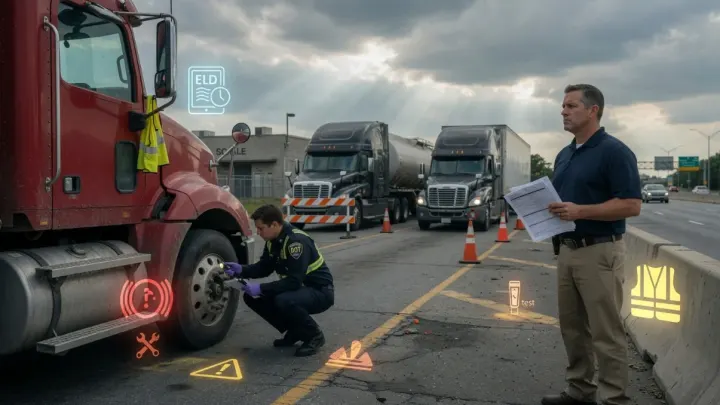
Running a small trucking fleet in the United States comes with constant pressure. Between managing drivers, keeping vehicles on the road, handling paperwork, and meeting customer deadlines, compliance often becomes one of the biggest challenges. While large carriers usually have dedicated compliance teams and advanced systems, small fleets rely on limited staff and tight budgets. This is one of the main reasons small fleets fail compliance more often and pay a much higher price for it.
The numbers confirm it. FMCSA violation data from May 2024 through February 2026 — covering roughly 6.2 million violations across 61 categories shows that fleets of 1 to 10 trucks account for 74% of inspection report problems, 73% of false logs, and 69% of emergency equipment citations. Even with fewer trucks on the road, small carriers are absorbing the lion's share of citations in nearly every major category.
From DOT drug and alcohol testing requirements to driver qualification files and FMCSA regulations, even a small mistake can lead to violations, fines, failed audits, or out-of-service orders. Many owner-operators underestimate how quickly compliance issues compound.
Understanding Fleet Compliance
Fleet compliance refers to following all rules and regulations required by the FMCSA and DOT. These regulations are designed to improve road safety, reduce accidents, and ensure drivers and fleets operate responsibly. Compliance includes DOT drug and alcohol testing, random drug testing consortium participation, driver qualification files, hours of service regulations, vehicle inspections and maintenance, Clearinghouse reporting, Return-to-Duty processes, and safety monitoring and recordkeeping. For small fleets, managing all these responsibilities without expert support can become overwhelming especially as 2026 brings stricter enforcement and faster violation detection across all compliance categories.
Why Small Fleets Struggle More with Compliance
Limited Staff and Resources
Most small fleets operate with fewer employees. In many cases, the owner handles dispatching, hiring, payroll, customer communication, and compliance simultaneously. Because of this, important compliance tasks are delayed or overlooked. Large carriers have compliance departments, safety managers, legal advisors, dedicated HR teams, and automated systems. Small fleets rarely have access to these resources, which directly increases the risk of violations.
Lack of Compliance Knowledge
DOT and FMCSA regulations change regularly and 2026 has been one of the most active years for regulatory updates in recent memory. Many small fleet owners focus more on operations and revenue than regulatory updates, meaning they miss critical changes such as Clearinghouse requirements, updated random testing percentages, driver file obligations, annual review schedules, and follow-up testing timelines. Even one missed requirement can create serious compliance problems during an audit.
2026 Enforcement Is Faster No More "Fix It Later"
A significant shift in 2026 is the speed of enforcement. In previous years, many carriers could identify issues during audits and correct them afterward. In 2026, CDL records are monitored more frequently and violations surface sooner through system integrations between FMCSA, state DMVs, and the Clearinghouse. Compliance gaps now create immediate operational risk especially for small fleets with no backup drivers or compliance buffer.
Drug and Alcohol Testing Challenges
One of the biggest reasons small fleets fail compliance is improper drug and alcohol testing management. DOT-regulated companies must follow strict testing rules including pre-employment drug testing, random drug testing, post-accident testing, reasonable suspicion testing, Return-to-Duty testing, and follow-up testing. Small fleets often struggle with maintaining proper records and scheduling tests on time. In 2025, FMCSA enforcement data revealed more than 100,000 violations across all carrier sizes with fines exceeding $125,000 in some cases — and drug and alcohol recordkeeping gaps remained among the top triggers.
Random Testing Consortium Mistakes
Owner-operators and small fleets are required to join a DOT-compliant random drug testing consortium if they do not manage their own random testing pool. Common mistakes include not enrolling in a consortium, missing random selections, delayed testing, poor recordkeeping, and incomplete reports. These mistakes can quickly lead to FMCSA violations and audit failures. Understand how a random testing consortium works to ensure your selection process meets federal requirements.
Poor Recordkeeping
Documentation is everything during a DOT audit. Small fleets often fail because they cannot provide complete or updated records. Critical documents include driver qualification files, medical certification status, drug testing records, maintenance records, hours of service logs, inspection reports, and Clearinghouse queries.
Incomplete Driver Qualification Files alone account for nearly 12% of all FMCSA violations. Under federal regulations, DQFs must be maintained for a minimum of 3 years after a driver leaves employment, and files must be accessible within 48 hours for remote audits. Missing paperwork creates the impression that the fleet is not operating safely regardless of actual road performance. Digital compliance systems and organized reporting services significantly reduce these risks.
Clearinghouse Compliance Issues
The FMCSA Drug and Alcohol Clearinghouse has become one of the most heavily enforced compliance requirements for trucking companies. Clearinghouse violations remained high entering 2026, with failures to run pre-employment or annual limited queries accounting for over 7,000 recorded violations industrywide. Violations can cost up to $5,833 per occurrence, and state licensing agencies now automatically revoke or deny CDLs for drivers with unresolved "prohibited" status.
Many small fleets fail compliance because they forget annual Clearinghouse queries, do not register properly, miss consent requirements, fail to report violations, or hire drivers without completing required checks. Review common Clearinghouse violations, penalties, and how to stay compliant before your next hiring cycle.
Driver Shortages Increase Compliance Risks
Small fleets already face driver shortages, and this pressure causes rushed hiring decisions. Some fleets skip proper background checks or fail to complete required testing before allowing drivers on the road. A proper hiring process must include DOT drug testing, Clearinghouse queries, license verification, medical certification checks, and driver history reviews. Compliance should never be sacrificed to fill positions quickly — one unqualified driver can expose the entire fleet to FMCSA penalties.
English Language Proficiency A New Out-of-Service Risk
Effective May 2025, FMCSA made English Language Proficiency (ELP) violations an Out-of-Service offense. This is a compliance area many small fleets have completely overlooked. A CDL alone does not prove English proficiency drivers must demonstrate real-time communication ability during roadside inspections under 49 CFR 391.11. Small fleets should conduct internal ELP assessments and document them in each driver's qualification file to avoid an immediate out-of-service order at a roadside inspection.
Budget Limitations
Many small fleets delay compliance services because of cost concerns. Unfortunately, avoiding compliance expenses almost always leads to bigger financial losses. Non-compliance can result in DOT fines, failed audits, insurance increases, lawsuits, out-of-service orders, and business reputation damage. Civil penalties can reach up to $1,270 per day per violation. Investing in reliable compliance support is consistently more affordable than dealing with penalties and downtime. Learn why every trucking company needs a TPA or C/TPA to manage compliance costs and risks efficiently.
Lack of Training
Drivers and managers need proper, ongoing compliance training not just at onboarding. Small fleets sometimes assume experienced drivers already understand DOT regulations, but rules change frequently. Training should cover drug and alcohol testing procedures, hours of service compliance, inspection requirements, accident reporting, safety protocols, Clearinghouse rules, and English Language Proficiency requirements. Consistent training reduces violations and improves overall fleet safety, including awareness of why marijuana legalization does not protect CDL drivers under federal testing rules.
Technology Gaps
Large fleets use advanced software for compliance tracking, driver management, and reporting. Small fleets may still rely on paper files or outdated systems. Without proper technology, it becomes harder to track testing schedules, monitor driver files, store records securely, manage inspections, and stay audit-ready.
The 2026 CSA scoring overhaul makes this gap even more dangerous. The FMCSA is consolidating 950+ individual violations into 116 categories, making patterns easier to detect and harder to dismiss. Small issues like repeated maintenance flags or improper driver logs now create major red flags under the revised scoring system. Modern compliance tools help reduce human error and keep small fleets from being penalized for patterns they did not even realize were forming.
Audit Preparation Problems
DOT audits can happen unexpectedly and are increasingly triggered by FMCSA's Safety Measurement System data rather than only after accidents or complaints. Small fleets that are not prepared struggle to organize documents and respond within the required timeframes. Common audit issues include missing testing records, expired medical certificates, incomplete driver files, unrecorded maintenance reports, and incorrect hours of service logs. Understand what DOT safety auditors look for and prepare year-round rather than reactively.
How Small Fleets Can Improve Compliance
Partner With a Compliance Service Provider
Working with experienced providers like goMDNow helps small fleets manage compliance more efficiently. Services include DOT drug testing, random consortium enrollment, Clearinghouse support, compliance reporting, follow-up testing management, and audit preparation assistance. Professional support reduces stress and keeps fleets organized. Explore the difference between a C/TPA and a drug testing clinic to choose the right compliance partner for your fleet size.
Use Digital Compliance Systems
Technology can automate compliance tasks including driver file tracking, random testing notifications, record storage, maintenance reminders, and audit preparation. Automation reduces manual work, improves accuracy, and ensures nothing falls through the cracks during busy operational periods.
Conduct Regular Internal Reviews
Small fleets should regularly review driver files, drug testing records, vehicle maintenance reports, hours of service logs, and Clearinghouse status. Finding problems early helps prevent serious violations later and in 2026, early detection matters more than ever since enforcement gaps are now closed faster than before.
Create a Compliance-First Culture
Compliance should become part of everyday operations, not an afterthought. Small fleets that prioritize safety and organization maintain better safety ratings, stronger customer trust, better insurance relationships, and improved driver accountability. Learn how trucking companies can build a DOT-compliant operation at every level of the business.
Benefits of Staying DOT Compliant
When small fleets maintain proper compliance, they gain lower risk of penalties, better safety performance, improved customer confidence, reduced accident risks, a stronger business reputation, easier audit management, and better operational efficiency. Compliance is not just about avoiding fines it creates a safer and more sustainable business that can compete for quality shippers and contracts.
Final Thoughts
Small fleets fail compliance more often because they operate with limited staff, smaller budgets, less technology, and fewer compliance resources. However, compliance problems are preventable with the right systems, training, and support. With 2026 bringing faster enforcement, a revamped CSA scoring model, English Language Proficiency out-of-service enforcement, and continued Clearinghouse pressure, small fleets that stay proactive can avoid costly violations and build stronger operations.
goMDNow helps owner-operators and trucking companies simplify DOT compliance through reliable testing services, consortium management, and compliance support across the USA. Contact us today to get started.
FAQs
1. Why do small trucking fleets fail compliance more often?
Small fleets often lack dedicated compliance staff, technology, and resources, making it
harder to manage DOT and FMCSA requirements. Data shows that fleets of 1–10 trucks
account for 74% of inspection report problems across all carrier sizes.
2. What is the biggest compliance issue for small fleets?
Drug and alcohol testing management, poor recordkeeping, and Clearinghouse violations are
among the most common compliance problems. Incomplete driver qualification files alone
account for nearly 12% of all FMCSA violations. Learn about
the FMCSA Drug and Alcohol Clearinghouse
and what reporting obligations apply.
3. Do owner-operators need a random drug testing consortium?
Yes owner-operators operating under DOT regulations must participate in a compliant
random drug testing consortium.
Failure to enroll can result in immediate violations during a DOT audit.
4. How can small fleets avoid DOT violations?
Using professional compliance services, maintaining organized digital records, training
drivers regularly, conducting internal audits, and monitoring Clearinghouse status are the
most effective strategies for reducing violations.
5. What is the new English Language Proficiency rule for drivers?
As of May 2025, FMCSA made ELP violations an Out-of-Service offense. Drivers must
demonstrate real-time English communication ability during roadside inspections a CDL
alone is not sufficient proof of proficiency.
6. How does goMDNow help small trucking companies?
goMDNow provides
DOT-compliant
drug testing, consortium enrollment, compliance support, and testing management services
for fleets and owner-operators across the USA.