
Every commercial driver and trucking employer in the U.S. must take the DOT Clearinghouse seriously. Introduced by the Federal Motor Carrier Safety Administration (FMCSA) in 2020, the Clearinghouse is a centralized database that tracks drug and alcohol violations for commercial drivers with a Commercial Driver's License (CDL). Its purpose is simple but critical: improve road safety by ensuring drivers with drug and alcohol program violations are identified and prevented from operating commercial motor vehicles (CMVs) until they've completed required rehabilitation procedures.
But what happens when employers or drivers fail to follow the rules? DOT Clearinghouse violations explained in this guide can disrupt careers. In this article, we'll break down what these violations are, common examples, real consequences, and best practices for avoiding them. This article is provided by goMDnow for informational purposes only. It is intended to offer general guidance regarding DOT Clearinghouse regulations.
This article reflects current FMCSA regulations under 49 CFR Part 382 and Part 40 and is intended for educational and compliance awareness purposes.
Understanding the DOT Clearinghouse
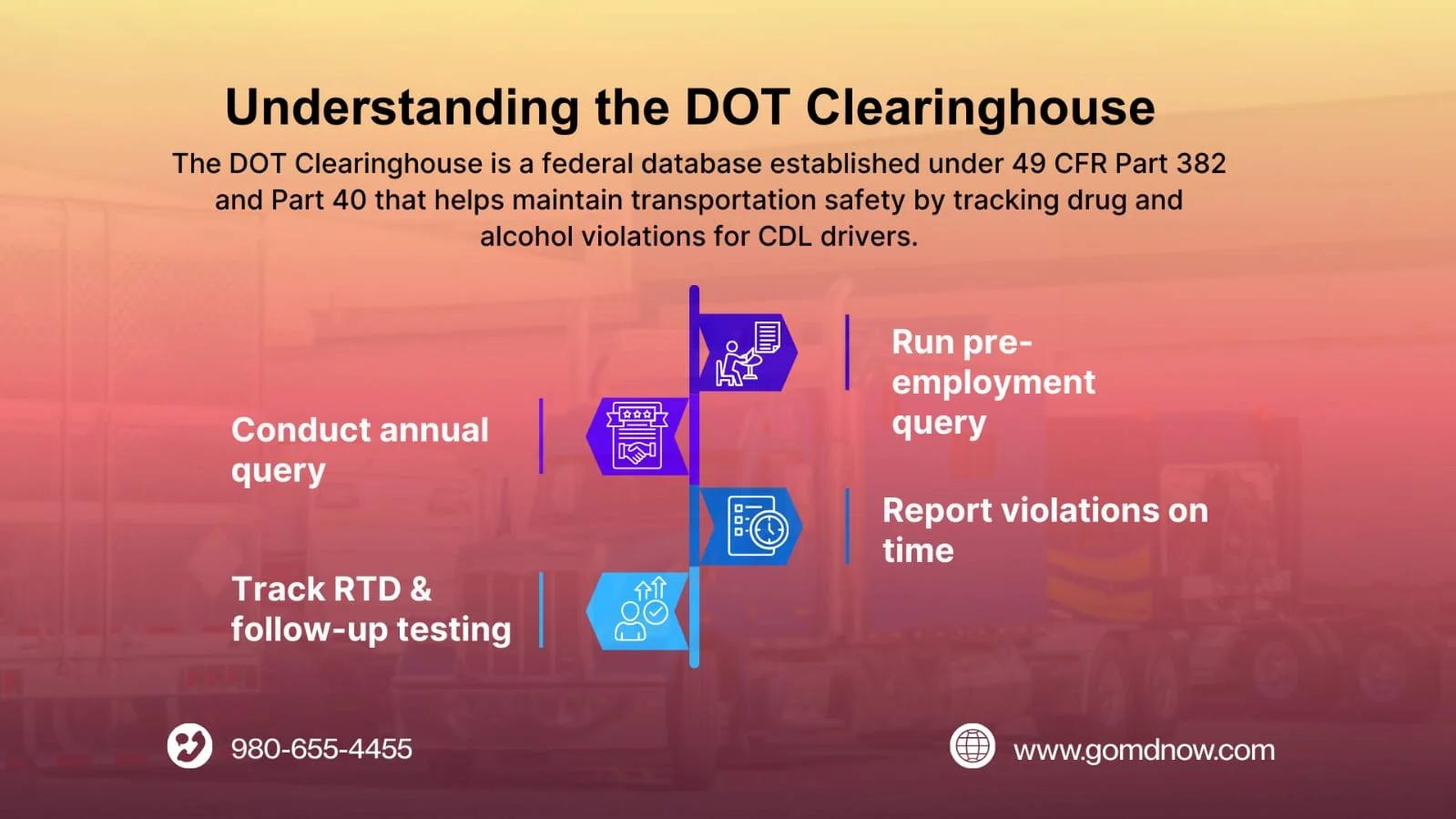
The DOT Clearinghouse is part of the federal regulations found in 49 CFR Part 382 and Part 40, which govern DOT drug and alcohol testing requirements. The Clearinghouse contains records of positive drug or alcohol tests, refusals to test, and return-to-duty (RTD) test results.
Drivers and employers must register with the Clearinghouse, and employers must:
- Run a pre-employment query on prospective drivers before they begin safety-sensitive work.
- Perform an annual query for each CDL driver.
- Report violations promptly.
- Track RTD status and follow-up testing completion.
A driver with an unresolved violation is placed in "prohibited status." This status legally bars them from operating a CMV until they complete the required evaluation and return-to-duty process. This ensures that drivers who may pose a safety risk due to substance abuse are not on the road, protecting everyone.
What Counts as a DOT Clearinghouse Violation?
Not every compliance failure triggers a Clearinghouse violation only violations associated with DOT-regulated drug and alcohol testing. Here are the primary categories:
1. Positive Drug or Alcohol Test Results
If a driver tests positive under DOT testing rules for marijuana, cocaine, amphetamines, or alcohol over the allowable limit that becomes a reportable violation in the Clearinghouse. Despite marijuana being legal in some states, it remains a DOT-prohibited substance for CDL drivers.
2. Refusals to Test
A refusal isn't just saying "no." It includes actions such as:
- Failing to report on time for testing.
- Leaving before the test is completed.
- Refusing to follow the testing process.
Any of these actions are considered violations if they fall under DOT drug and alcohol testing rules. Refusals are treated as seriously as a positive test because they prevent verification of a driver's compliance.
3. Failure to Perform Required Queries
Employers must query the Clearinghouse at key stages:
- Before hiring a driver.
- On at least an annual basis for current drivers.
Failing to perform either of these queries or allowing a driver to work before getting query results is a common compliance violation. Even if a driver has no violations, skipping this step is a regulatory failure.
4. Late or Inaccurate Reporting
Employers must report drug and alcohol program violations within three business days of learning about them. Delays or inaccuracies such as reporting the wrong driver or the wrong result are violations that can result in fines and complicate a driver's prohibited status.
5. Missing Return-to-Duty Reporting
After a driver completes required counseling and follow-up testing, the employer must report the negative RTD results. One of the most common Clearinghouse violations occurs when this step isn't completed properly or on time.
Real Consequences of DOT Clearinghouse Violations
Driver Consequences
- Prohibited Status: The driver cannot legally operate any CMV until completing the return-to-duty (RTD) process.
- CDL Downgrade: Drivers in prohibited status may have their CDL automatically downgraded, limiting their commercial driving privileges.
- Employment Impact: Pending violations appear to future employers during pre-employment queries, often costing job opportunities and income.
- Stress and Career Disruption: Being in prohibited status can create anxiety and long-term career uncertainty, emphasizing the importance of compliance.
Employer Consequences
- Fines and Penalties: The FMCSA imposes fines for violations ranging thousands of dollars per instance. Some fines exceed $7,000 to $10,000 per violation.
- Safety and Compliance Scores: A violation negatively impacts a carrier's Safety, Accountability & Compliance (CSA) score, which can lead to audits and regulatory intervention.
- Legal Risk: Allowing a prohibited driver to operate can expose a company to liability in an accident, potentially leading to lawsuits, insurance premium hikes, and reputational damage.
Examples of Common DOT Clearinghouse Violations
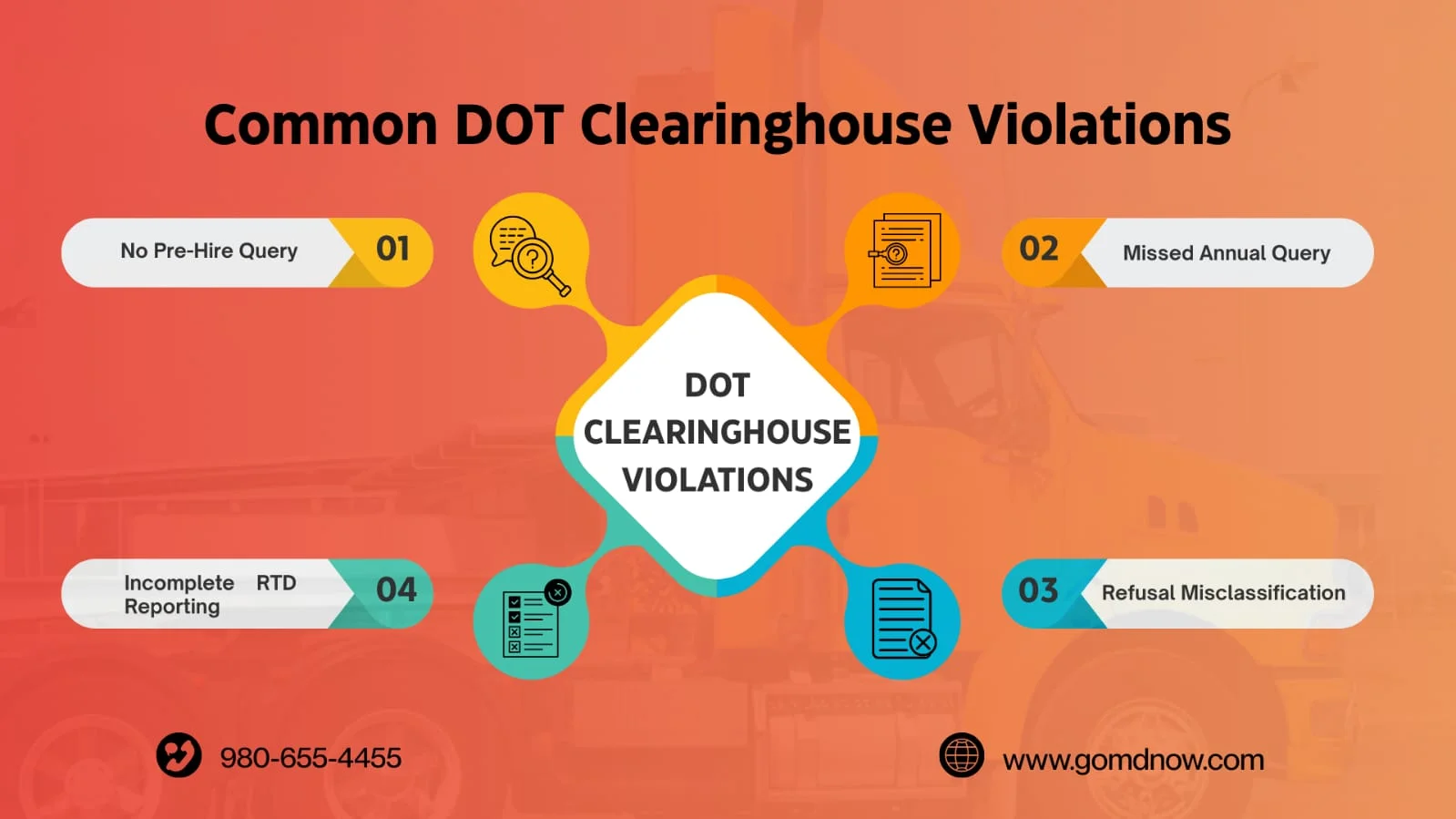
Failing to Check Before Hiring
A trucking company hires a new driver without running the mandatory Clearinghouse query. Later, the driver tests positive for drugs. Now the employer faces a violation for skipping the pre-employment check and must take corrective action.
Forgetting the Annual Query
An employer completes the pre-employment query but then forgets to conduct the required annual query. This oversight is considered a compliance failure and can result in fines and audit flags.
Incomplete Reporting
A driver completes RTD testing after rehabilitation, but the employer fails to report the negative result. The driver remains incorrectly flagged as prohibited, which can lead to additional fines and employment disputes.
Refusal Misclassification
Sometimes employers misclassify a driver's refusal to test or fail to update the database correctly. This creates legal confusion and may result in a prolonged prohibited status unnecessarily. Learn more about what happens after a DOT violation.
How Employers and Drivers Can Avoid Violations
Automate Clearinghouse Queries
Use software or compliance services to ensure you run queries at the right times pre-hire and annually. Automation reduces human error and keeps you audit-ready.
Train HR and Safety Teams
Make sure your HR, safety, and compliance personnel understand DOT drug and alcohol Clearinghouse reporting requirements including what counts as a violation and when reports are due.
Maintain Accurate Records
Keep up-to-date driver information including correct CDL numbers, state of issuance, and any updates that must be reflected in Clearinghouse records. Accurate records are the foundation of compliance.
Use Third-Party Compliance Help
Smaller carriers often benefit from designating a third-party administrator (TPA) to manage Clearinghouse queries and reports. TPAs specialize in regulatory compliance, reducing human error and liability.
Conduct Internal Audits
Quarterly compliance audits can catch gaps before they become violations saving time, money, and preventing disruptions to operations. Audits ensure your policies match FMCSA requirements and highlight training needs. Learn more about maintaining DOT compliance.
Educate Drivers
Drivers should understand their responsibilities including completing tests, reporting accurately, and complying with RTD requirements. Education prevents misunderstandings and reduces unintentional violations.
How goMDnow Helps You Stay Compliant
At goMDnow, we provide comprehensive DOT compliance solutions designed to prevent Clearinghouse violations before they occur:
- Automated pre-employment and annual Clearinghouse queries
- DOT-compliant drug testing services nationwide
- Timely violation reporting and documentation
- Random testing consortium management
- Return-to-duty program coordination
- Full audit support and compliance recordkeeping
Whether you're an owner-operator, small fleet, or large carrier, our services ensure you meet all Clearinghouse requirements without the administrative burden.
Conclusion
DOT Clearinghouse violations can have serious consequences for both CDL drivers and employers. From positive drug or alcohol tests to missed queries and reporting errors, even small compliance gaps can lead to prohibited status, fines, CDL downgrade, or operational disruption. The Clearinghouse is not just a database it is a federal safety system designed to keep unsafe drivers off the road and maintain accountability across the transportation industry.
At goMDnow, we support employers, owner-operators, and CDL drivers with reliable DOT-compliant drug and alcohol testing services. Staying informed and proactive is the best way to prevent violations, avoid penalties, and keep your operations running smoothly.
Frequently Asked Questions
Is a missed annual query a DOT Clearinghouse violation?
Yes. Employers must run annual queries for all CDL drivers or face compliance penalties.
Can a driver work while in prohibited status?
No. Federal law prohibits drivers from performing safety-sensitive duties until the RTD process is completed.
How fast must employers report Clearinghouse violations?
Within three business days of learning about the violation.
What testing is included in the DOT drug screen?
The DOT uses a 5-panel drug test with specific cut-off levels for marijuana, cocaine, amphetamines, opiates, and PCP.
How does the return-to-duty process work?
After a violation, drivers must complete a SAP evaluation, follow recommended treatment, pass a return-to-duty test, and undergo follow-up testing with MRO verification.
Can I use a consortium to manage Clearinghouse compliance?
Yes. Many employers, especially owner-operators and small fleets, use a C/TPA to handle all Clearinghouse queries, reporting, and testing coordination.