
The trucking industry plays a critical role in keeping goods moving across the United States. However, with that responsibility comes the need to follow strict federal safety rules. For trucking companies, staying DOT compliant is not optional it is essential for legal operations, driver safety, and business growth.
The Department of Transportation (DOT) and the Federal Motor Carrier Safety Administration (FMCSA) regulate trucking companies to ensure roads remain safe for everyone. Failing to meet these standards can lead to penalties, failed audits, out-of-service orders, and damage to your company's reputation.
In this guide, we explain the key DOT compliance requirements for trucking companies, common mistakes to avoid, and how goMDnow can help simplify the compliance process.
What Does DOT Compliant Mean for Trucking Companies?
Being DOT compliant means your trucking company follows all rules and regulations set by the DOT and FMCSA. These regulations cover areas such as:
- Driver qualification files
- Drug and alcohol testing programs
- Hours of Service (HOS) compliance
- Vehicle inspections and maintenance
- Commercial driver licensing requirements
- Safety training and recordkeeping
- Accident reporting and audits
DOT compliance helps reduce accidents, improve fleet performance, and protect your company from costly fines. Review the DOT rules and regulations you cannot afford to ignore for a broader overview of federal requirements.
Why DOT Compliance Is Important
Many trucking companies focus only on deliveries and operations, but compliance should be part of daily management. Here's why:
1. Avoid Heavy Penalties
DOT violations can result in significant fines depending on the issue. See the five most costly compliance failures that get trucking companies fined $5,000 or more.
2. Protect Drivers and the Public
Compliance standards are designed to improve road safety for everyone on the highway.
3. Pass DOT Audits
New carriers and established fleets may face audits and inspections. Learn what DOT safety auditors look for during a compliance review.
4. Improve Business Reputation
Shippers and clients prefer working with reliable, compliant carriers.
5. Reduce Downtime
Well-maintained trucks and organized records prevent delays and out-of-service orders.
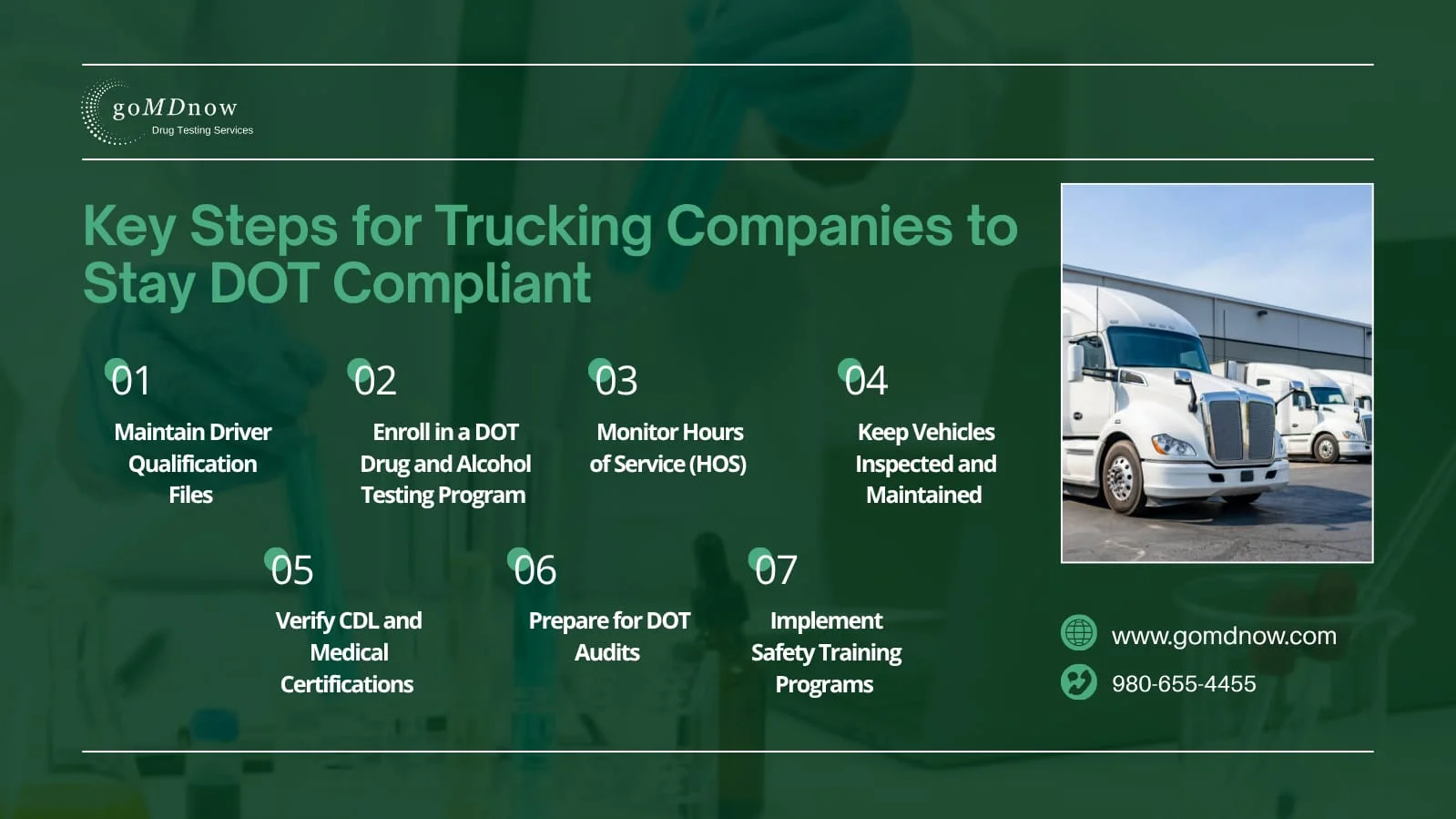
Key Steps for Trucking Companies to Stay DOT Compliant
1. Maintain Driver Qualification Files
Every trucking company must keep updated Driver Qualification Files (DQFs) for each driver. These files typically include:
- Employment application
- Motor Vehicle Record (MVR) checks now also the required method for medical certification verification as of January 10, 2026
- CDL copy
- Medical Examiner's Certificate note that after January 10, 2026, motor carriers must verify CDL driver medical certifications exclusively through MVRs. The paper MEC waiver has expired. Carriers must stop collecting paper MECs from CDL drivers and verify medical status through state MVR systems instead
- Road test certificate
- Safety performance history
- Annual review records
Missing or outdated files are among the most common DOT violations. Understand what qualifies as a DOT violation and the penalties that follow.
2. Enroll in a DOT Drug and Alcohol Testing Program
A DOT-regulated trucking company must have a compliant drug and alcohol testing program for all safety-sensitive drivers. Required testing types include:
- Pre-employment drug testing
- Random drug and alcohol testing 2026 FMCSA rates remain at 50% for drugs and 10% for alcohol
- Post-accident testing
- Reasonable suspicion testing
- Return-to-duty testing
- Follow-up testing
Partnering with a professional compliance provider like goMDnow can make this process easier by managing testing programs, paperwork, and scheduling. Understand the difference between DOT and non-DOT drug testing programs to ensure your program covers the right employees.
3. Monitor Hours of Service (HOS)
Truck drivers must follow Hours of Service regulations to reduce fatigue-related accidents. This includes limits on driving hours, duty hours, rest breaks, and weekly driving caps. Most carriers use Electronic Logging Devices (ELDs) to track driver hours accurately.
Failure to manage HOS records can trigger audits and violations. An important 2026 note: verify that your ELD is still on the FMCSA's approved list FMCSA removed 9 ELDs from its registered list in February 2026. Using a decertified ELD is itself a compliance violation. FMCSA also launched two HOS pilot programs in early 2026 studying increased flexibility in driving window rules monitor FMCSA announcements for updates that may affect your fleet.
4. Keep Vehicles Inspected and Maintained
Commercial trucks must be safe to operate at all times. DOT requires:
- Pre-trip inspections
- Post-trip inspections
- Routine maintenance schedules
- Annual DOT inspections
- Repair documentation
A preventive maintenance system helps avoid breakdowns and roadside violations during CVSA enforcement blitzes.
5. Verify CDL and Medical Certifications
Drivers operating commercial vehicles must hold a valid Commercial Driver's License (CDL) and current medical certification. As noted above, as of January 10, 2026, medical certification must be verified through MVRs not paper MECs.
Additionally, FMCSA made English Language Proficiency (ELP) violations an Out-of-Service offense as of May 2025. A CDL alone does not prove English proficiency drivers must demonstrate real-time communication ability during roadside inspections under 49 CFR 391.11. Carriers should conduct internal ELP assessments and document them in driver qualification files.
Trucking companies should monitor expiration dates and renewals through state MVR systems to prevent non-compliance. The FMCSA Clearinghouse also tracks violations as of November 18, 2024, unresolved violations trigger automatic CDL downgrades through SDLA integration. See how the FMCSA Drug and Alcohol Clearinghouse affects CDL status.
6. Prepare for DOT Audits
DOT audits can happen at different stages of business operations. Carriers should always be ready with organized records. Common audit requests include:
- Driver qualification files
- Drug testing records
- Maintenance logs
- HOS logs
- Accident register
- Insurance documents
Regular internal reviews help companies stay prepared year-round. Working with a qualified C/TPA or certified testing clinic ensures your drug testing records are always audit-ready.
7. Implement Safety Training Programs
Driver safety training reduces incidents and strengthens compliance culture. Topics may include:
- Defensive driving
- Drug and alcohol awareness including understanding why marijuana legalization does not protect CDL drivers under federal rules
- Vehicle inspections
- HOS rules
- Accident procedures
- Cargo securement
Well-trained drivers are less likely to cause costly violations and out-of-service events.
Common DOT Compliance Mistakes Trucking Companies Make
Even experienced fleets can make compliance errors. Common mistakes include:
- Not joining a random drug testing consortium
- Missing random drug testing selections
- Incomplete driver files
- Expired CDL or medical cards now must be verified through MVR, not paper MEC
- Using a decertified ELD device
- Poor maintenance records
- False or missing ELD logs
- Late accident reporting
- Lack of supervisor reasonable suspicion training
- Ignoring English Language Proficiency requirements
Avoiding these issues can save thousands in penalties and prevent operational shutdowns.
How Small Trucking Companies Can Stay Compliant
Small carriers often have limited staff, making compliance more challenging. Here are smart solutions:
Use Digital Compliance Tools
Track documents, reminders, and renewals electronically.
Outsource Compliance Services
Use trusted providers for testing and recordkeeping. Learn why every trucking company needs a TPA or C/TPA.
Conduct Monthly Reviews
Catch issues before inspections happen.
Train Drivers Regularly
Compliance starts with informed drivers.
How goMDnow Helps Trucking Companies Stay DOT Compliant
Managing compliance manually takes time and increases risk. goMDnow supports trucking companies with dependable compliance solutions designed for modern fleets.
Services may include:
- DOT drug and alcohol testing programs
- Random testing management and consortium enrollment
- Mobile and nationwide testing options
- Fast scheduling and reporting
- Compliance guidance
- Easy record management support
Whether you run a single truck or a large fleet, goMDnow helps simplify compliance so you can focus on operations. Explore our nationwide testing network and drug testing pricing.
Benefits of Staying DOT Compliant
Companies that prioritize compliance often experience:
- Fewer violations and penalties
- Lower accident risk
- Better CSA scores
- Higher client and shipper trust
- Less downtime
- Stronger long-term growth
Compliance is not just about avoiding penalties it is a business advantage.
Final Thoughts
DOT compliance is one of the most important responsibilities for any trucking company. From driver files and drug testing to HOS tracking and truck maintenance, every part of your operation matters.
The best approach is to build compliance into your daily workflow instead of treating it as a last-minute task. Organized records, trained drivers, and reliable partners can make all the difference.
If your company needs dependable support, goMDnow offers professional solutions to help trucking companies stay compliant, efficient, and ready for the road. Contact us today to get started.
FAQs
1. What does DOT compliant mean for a trucking company?
It means the company follows FMCSA and DOT regulations for drivers, vehicles, testing, and safety operations including drug testing, driver qualification files, HOS tracking, and vehicle maintenance.
2. Is drug testing mandatory for trucking companies?
Yes. Companies with safety-sensitive CDL drivers must follow DOT drug and alcohol testing rules including the DOT 5-panel urine drug test for all required testing events.
3. How often are trucks required to be inspected?
Commercial vehicles require pre-trip and post-trip inspections and at least one annual DOT inspection. Routine preventive maintenance documentation is also required.
4. What happens if a trucking company fails a DOT audit?
The company may face fines, corrective action plans, conditional safety ratings, or operational restrictions. Repeat violations can lead to out-of-service orders.
5. How can goMDnow help with DOT compliance?
goMDnow helps with drug testing programs, consortium management, compliance support, scheduling, and record management for trucking companies of all sizes.