

DOT Requirements for Leased Owner-Operators
Leased owner-operators play a critical role in the U.S. trucking industry, but operating under a motor carrier lease agreement comes with strict compliance responsibilities. The Department of Transportation (DOT) and the FMCSA enforce regulations that ensure safety, accountability, and operational transparency for all commercial drivers.
This guide explains the DOT requirements for leased owner-operators, key compliance rules, drug and alcohol testing obligations, paperwork, and how compliance services like goMDnow can simplify the entire process.
What Is a Leased Owner-Operator?
A leased owner-operator is a truck driver who owns or finances their commercial vehicle but operates under a lease agreement with a motor carrier. Instead of running independently under their own authority, they "lease on" to a company that provides operating authority, insurance, and freight opportunities.
While this arrangement reduces administrative burden, leased owner-operators are still fully responsible for meeting DOT compliance requirements the same as any other CDL driver in safety-sensitive service.
Why DOT Compliance Matters
DOT compliance is not optional it is legally required for all commercial motor vehicle (CMV) operators engaged in interstate commerce. Failure to comply can result in heavy fines and penalties, loss of driving privileges, FMCSA audit failures, contract termination with motor carriers, increased insurance costs, and CSA score damage. See the most costly compliance failures that get trucking companies fined $5,000+.
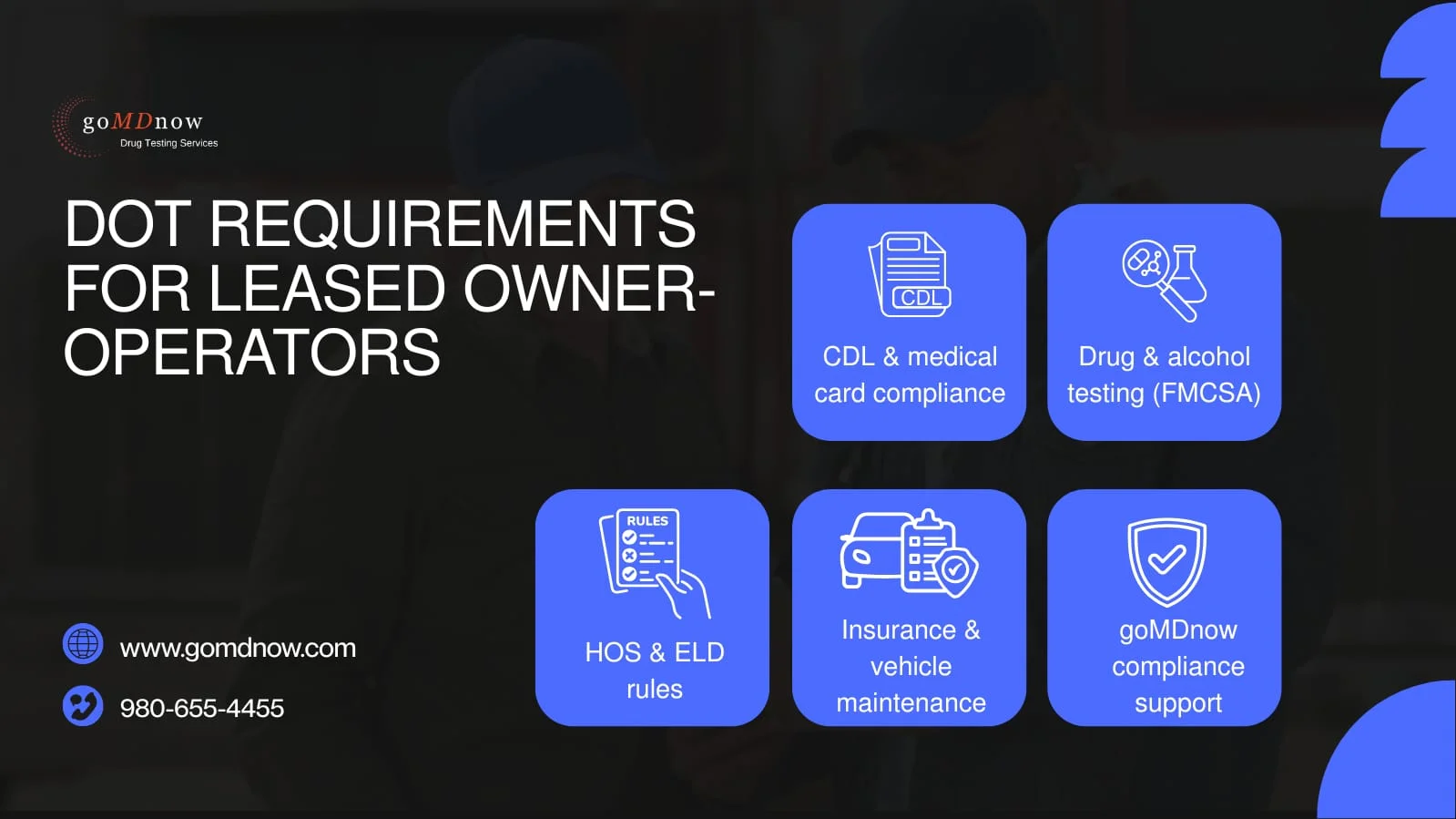
Key DOT Requirements for Leased Owner-Operators
1. CDL and Medical Certification
Every leased owner-operator must maintain a valid Commercial Driver's License (CDL) and a current DOT Medical Examiner's Certificate. Drivers must pass a physical exam conducted by a certified medical examiner listed in the National Registry.
Important 2026 update: The paper Medical Examiner's Certificate (MEC) waiver expired January 10, 2026. Motor carriers must now verify CDL driver medical certifications exclusively through Motor Vehicle Records (MVRs). Drivers and carriers should no longer rely on paper MECs the medical examiner now submits results directly to the FMCSA National Registry for electronic posting to the driver's CDLIS record. Expired medical cards or invalid CDLs result in immediate out-of-service orders.
2. Drug and Alcohol Testing Compliance
One of the most critical DOT requirements is participation in a drug and alcohol testing program regulated by the FMCSA. Leased owner-operators must comply with pre-employment drug testing, random drug and alcohol testing, post-accident testing, reasonable suspicion testing, return-to-duty testing, and follow-up testing if previously violated.
Most leased operators must enroll in a Consortium/Third-Party Administrator (C/TPA) program to be included in random testing pools. Learn why every leased owner-operator needs a TPA or C/TPA.
3. DOT Clearinghouse Registration
Drivers must register at the FMCSA Drug & Alcohol Clearinghouse, which tracks violations and testing records. Requirements include providing annual query consent to carriers, full queries before hiring or leasing, reporting violations or positive test results, and maintaining active driver consent.
Critical 2024–2026 update: As of November 18, 2024, State Driver Licensing Agencies are required to downgrade commercial driving privileges for any driver with a "prohibited" status in the Clearinghouse meaning drivers cannot operate commercial vehicles until they complete the full return-to-duty process. Learn about Clearinghouse violations and how to avoid them.
4. Hours of Service (HOS) Rules
Leased owner-operators must follow strict Hours of Service regulations: maximum 11 hours driving per day, 14-hour on-duty window, 30-minute break after 8 hours of driving, 60/70-hour weekly limits, and mandatory ELD usage. HOS violations are heavily monitored during roadside inspections and audits.
5. Electronic Logging Device (ELD) Compliance
Most leased owner-operators are required to use an FMCSA-approved ELD system to track driving hours accurately. Non-compliance can result in citations or out-of-service orders. Important: FMCSA removed multiple ELD devices from its registered list in late 2025 and early 2026. Verify your ELD is still on the approved list using a decertified device is itself a violation.
6. Vehicle Inspection and Maintenance
DOT requires leased owner-operators to maintain their commercial vehicles in safe working conditions. This includes pre-trip inspections, post-trip inspections, annual DOT inspections, maintenance records, and repair documentation. Vehicles must meet Federal Motor Carrier Safety Regulations (FMCSR) standards at all times. Electronic DVIRs were officially authorized under FMCSA-2025-0115 effective March 23, 2026.
7. Insurance Requirements
Leased owner-operators must carry appropriate insurance coverage based on their carrier agreement. Under 49 CFR Part 387, minimum liability requirements apply. Common coverage types include primary liability insurance, cargo insurance, physical damage coverage, and bobtail/non-trucking liability insurance. Note: MC numbers were eliminated effective October 1, 2025 FMCSA now uses USDOT numbers as the sole federal carrier identifier. All lease agreements, insurance filings (BMC-91/BMC-91X), and documentation must reflect the USDOT number only.
8. Driver Qualification File (DQF)
Carriers maintain a Driver Qualification File for each leased owner-operator, which includes CDL copy, medical certificate (now verified through MVR), employment history, MVR, drug and alcohol testing records, and safety performance history. Missing documents can result in compliance violations during DOT safety audits. DQF gaps account for nearly 12% of all FMCSA violations.
9. English Language Proficiency
As of May 2025, English Language Proficiency (ELP) violations are an Out-of-Service offense under 49 CFR 391.11. Commercial drivers must be able to read and speak English well enough to understand road signs, communicate with officials, and complete required paperwork. Noncompliant drivers are taken out of service on the spot a CDL alone does not prove English proficiency. Leased operators and carriers should conduct ELP assessments and document them in driver qualification files.
10. Lease Agreement Compliance
Leased owner-operators must follow the terms of their lease agreement with the carrier, including revenue split structure, fuel surcharge policies, dispatch rules, equipment usage requirements, and insurance responsibilities. The lease agreement must comply with DOT truth-in-leasing regulations under 49 CFR Part 376. A copy of the lease must either be carried on the equipment or available via a certified statement during the lease period.
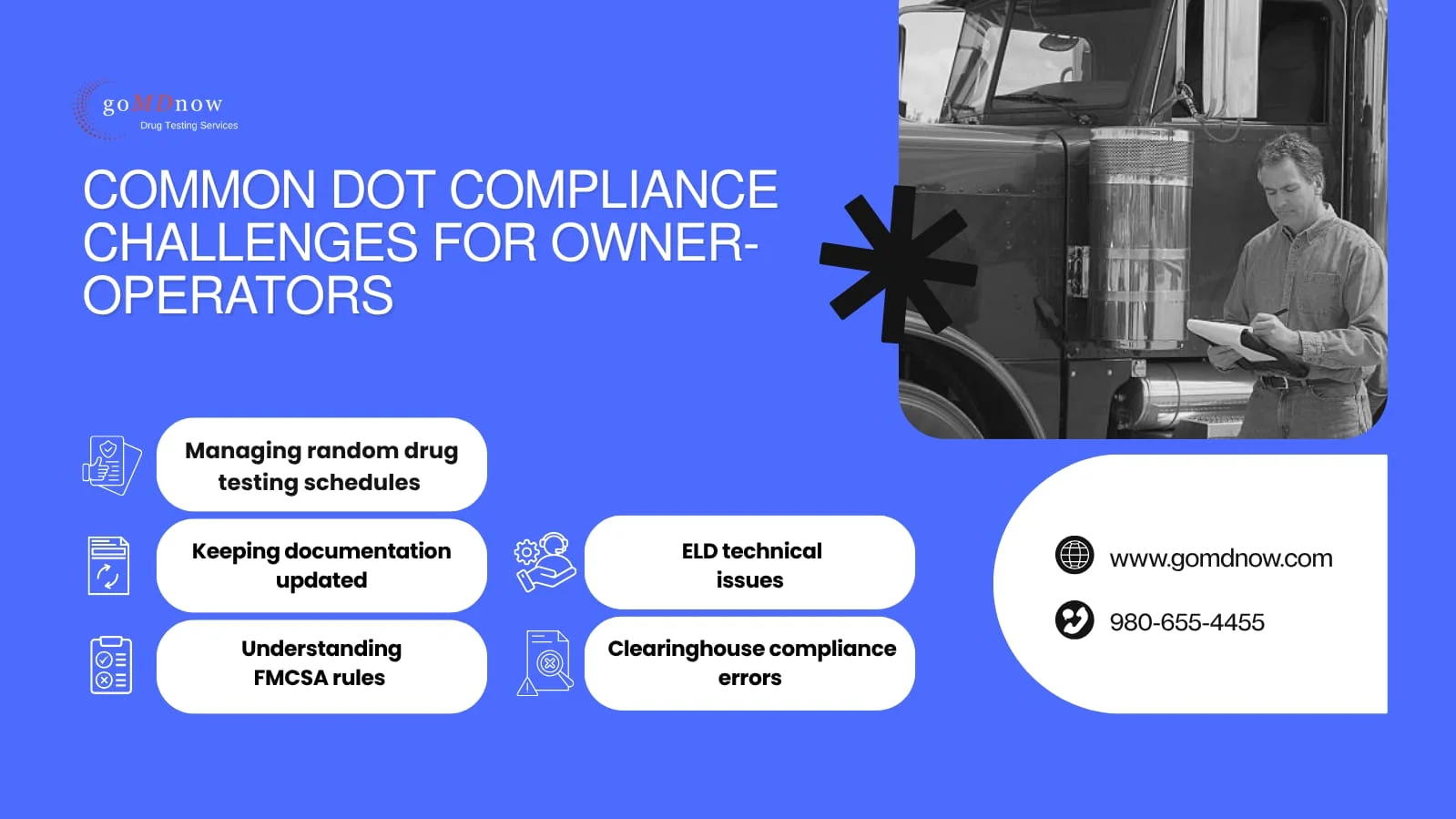
Common DOT Compliance Challenges for Owner-Operators
Many leased operators struggle with:
- Managing random drug testing schedules — enroll in a DOT random testing consortium to simplify this
- Keeping documentation updated — especially with the 2026 medical certification MVR transition
- Understanding FMCSA rules — see what qualifies as a DOT violation
- ELD technical issues — including potential use of now-decertified devices
- Clearinghouse compliance errors
- MC number transition — all documentation must now show USDOT number only
How goMDnow Helps Leased Owner-Operators
goMDnow provides end-to-end compliance support designed specifically for truck drivers and fleets. Services include DOT drug and alcohol testing enrollment, random consortium management, Clearinghouse assistance, compliance documentation support, audit preparation guidance, and follow-up testing coordination.
By outsourcing compliance management, owner-operators can focus on driving and earning while reducing the risk of violations. Explore our nationwide testing network, review our drug testing pricing, or contact us today.
Benefits of Staying DOT Compliant
Maintaining compliance provides major advantages: smooth carrier relationships, higher earning potential, fewer roadside violations, lower insurance risks, better safety ratings, and long-term business stability. Compliance is not just a legal requirement it is a business asset.
Conclusion
DOT compliance for leased owner-operators is a multi-layered responsibility covering licensing, drug testing, hours of service, insurance, inspections, and documentation. Understanding and maintaining these requirements is essential for avoiding penalties and sustaining a profitable trucking operation.
The 2025–2026 regulatory landscape has brought meaningful changes from the MC number elimination and paper MEC expiration to Clearinghouse CDL downgrade enforcement and ELP Out-of-Service requirements. Leased operators who stay current with these updates protect their CDL, their contracts, and their livelihoods.
FAQs
1. Do leased owner-operators need DOT drug testing?
Yes. They must participate in FMCSA-compliant drug and alcohol testing programs including the DOT 5-panel urine drug test for all required testing events including random testing.
2. What is required for DOT compliance?
CDL, current medical certification (now verified through MVR), ELD logs, drug testing program enrollment, insurance, vehicle inspection records, and a current Driver Qualification File.
3. Are leased owner-operators subject to FMCSA rules?
Yes. All interstate commercial drivers must follow FMCSA regulations regardless of whether they operate under their own authority or under a carrier lease.
4. What is a Driver Qualification File (DQF)?
A file maintained by the carrier containing all driver compliance documents and records including CDL, medical certification, MVR, drug testing records, and safety performance history. DQF gaps are one of the most common FMCSA audit violations.
5. Why is DOT compliance important?
It ensures safe, legal operation and protects drivers from fines, CDL downgrades, contract terminations, and violations. Non-compliance can result in immediate out-of-service orders and Clearinghouse reporting that affects future employment.