

Commercial drivers operating under Department of Transportation (DOT) regulations are responsible for maintaining a drug- and alcohol-free workplace. One of the most important compliance requirements is participating in mandatory DOT drug and alcohol testing whenever instructed by an employer. These tests help ensure that drivers performing safety-sensitive duties are fit to operate commercial motor vehicles safely.
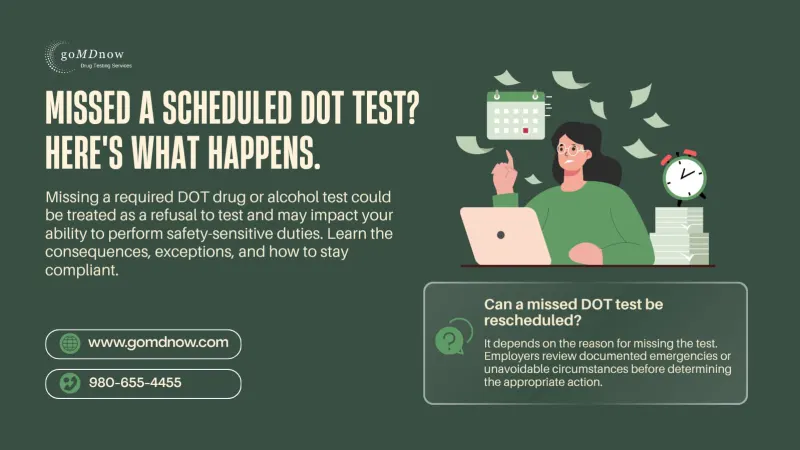
But what happens if a driver misses a scheduled DOT test? The answer depends on the circumstances. In many cases, missing a required DOT drug or alcohol test after receiving notification is treated as a refusal to test, which carries the same consequences as a verified positive drug test. However, certain situations, such as genuine medical emergencies or circumstances beyond the driver's control, may require further review by the employer.
Understanding how DOT regulations apply in 2026, including recent ODAPC clarifications on DER responsibilities and automated Clearinghouse monitoring, can help both drivers and employers avoid compliance violations, unnecessary penalties, and disruptions to employment.
2026 Update: ODAPC Clarifies DER Responsibilities for Refusals
In early 2026, the DOT Office of Drug and Alcohol Policy and Compliance (ODAPC) updated its Employer Handbook to clarify the specific responsibilities of the Designated Employer Representative (DER) when an employee refusal occurs at a collection site. This update addresses situations where a driver arrives for testing but engages in behavior at the collection site - leaving early, refusing to provide a specimen, or interfering with procedures - that must be classified and reported. DERs are now expected to follow more explicit documentation steps when a collection-site refusal occurs, and to coordinate directly with the collector or MRO to ensure the incident is properly recorded in the FMCSA Clearinghouse.
Marijuana Rescheduling Does Not Change Testing Rules
On December 18, 2025, an Executive Order directed the Department of Justice to reschedule marijuana from a Schedule I to a Schedule III drug. This has led to questions about whether DOT's longstanding restrictions on marijuana use for safety-sensitive transportation employees have changed. They have not. DOT has confirmed that the drug and alcohol testing process is unchanged - marijuana remains prohibited for pilots, school bus drivers, truck drivers, train engineers, ship captains, aircraft mechanics, and all other safety-sensitive transportation workers, regardless of state legalization or federal rescheduling status. This is directly relevant to missed test situations, since a driver cannot use rescheduling as a basis for delaying or refusing a required test. Learn more about why marijuana legalization does not protect CDL drivers under federal rules.
Why DOT Drug and Alcohol Testing Is Important
The Department of Transportation requires drug and alcohol testing for employees who perform safety-sensitive functions. These regulations are designed to protect drivers, employers, passengers, and the public by reducing the risk of impaired driving. Regular testing helps employers maintain DOT compliance, promote workplace safety, reduce accident risks, detect prohibited drug use, and meet federal regulatory requirements. For drivers, complying with testing requirements demonstrates professionalism and helps maintain eligibility for safety-sensitive work.
Types of DOT Tests Drivers May Be Required to Take
DOT regulations require testing in different situations throughout a driver's employment, and all are checked during a compliance review - there are no exceptions.
Pre-employment testing - Before performing safety-sensitive duties, drivers must successfully complete a DOT drug test.
Random drug testing - Drivers may be selected for random testing at any time during the year, at confirmed 2026 rates of 50% for drugs and 10% for alcohol. Employees must report immediately once notified.
Reasonable suspicion testing - If a trained supervisor observes signs of possible drug or alcohol use, the employer may require immediate testing. Learn about reasonable suspicion testing requirements and supervisor training obligations.
Post-accident testing - Certain accidents require DOT drug and alcohol testing depending on the circumstances outlined in federal regulations.
Return-to-duty testing - Drivers returning to safety-sensitive duties after a DOT violation must complete a return-to-duty test before resuming work.
Follow-up testing - After returning to work, drivers must complete a minimum of six unannounced follow-up tests within the first 12 months, as directed by a Substance Abuse Professional (SAP). This minimum can increase depending on the SAP's discretion or the recurrence of violations.
What Is Considered a Missed DOT Test?
A missed DOT test does not only mean failing to show up for an appointment. It can include several situations where a required test is not successfully completed: failing to report after receiving notification, arriving after the allowed testing window has closed, leaving the collection site before the test is complete, refusing to provide a urine specimen, refusing an alcohol breath test, delaying the testing process without a valid reason, or failing to cooperate with collection procedures. Understand what proper collection procedures require so drivers know exactly what compliant participation looks like.
Is Missing a Scheduled DOT Test Considered a Refusal?
In many situations, yes. If a driver has been officially notified to report for testing and fails to appear without a legitimate reason, the employer may classify the incident as a refusal to test. Examples of actions that may be considered a refusal include ignoring instructions to report for testing, leaving before completing the testing process, refusing to provide an adequate specimen without a valid medical explanation, refusing to sign required testing documents, tampering with or attempting to adulterate the specimen, or deliberately delaying testing after notification.
A refusal to test is treated seriously because it undermines the integrity of the DOT drug and alcohol testing program. Under the 2026 ODAPC clarification, DERs now have more explicit direction on how to document and report these incidents at the collection site itself, closing gaps that previously led to inconsistent handling.
Situations That May Not Be Considered a Refusal
Not every missed test automatically results in a refusal determination. Employers may review documented circumstances such as medical emergencies (a sudden illness or hospitalization that prevents reporting), vehicle breakdowns (if the driver communicates immediately with the employer), severe weather (flooding, snowstorms, or other dangerous conditions that make travel impossible), family emergencies involving immediate family members, or other circumstances beyond the driver's control. Each situation is evaluated individually based on DOT regulations and supporting documentation. Immediate communication with the employer is essential whenever an unexpected situation occurs.
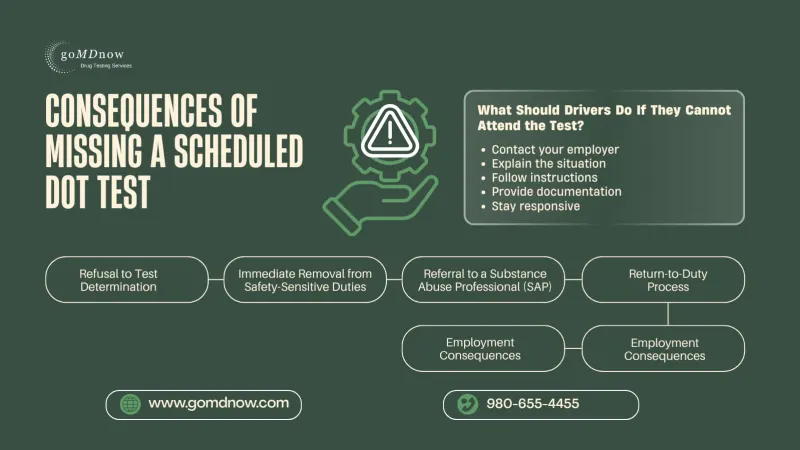
Consequences of Missing a Scheduled DOT Test
1. Refusal to Test Determination
If the employer determines that the driver refused testing, DOT regulations require immediate action. A refusal generally carries the same consequences as a verified positive drug test - including entry into the FMCSA Drug and Alcohol Clearinghouse. Learn how the FMCSA Drug and Alcohol Clearinghouse tracks refusals alongside positive tests and adulterated specimens.
2. Immediate Removal from Safety-Sensitive Duties
Drivers who refuse a required DOT test cannot continue performing safety-sensitive work. They must be removed from duties until completing the required return-to-duty process.
3. Referral to a Substance Abuse Professional (SAP)
Drivers must be evaluated by a qualified SAP, who determines what education or treatment is necessary before returning to work. The SAP develops a plan that the driver must successfully complete. Under the 2026 Clearinghouse system, if a driver goes more than 45 days without documented SAP progress, the system automatically flags the case and sends alerts - adding another layer of urgency to beginning this step quickly.
4. Return-to-Duty Process
Before returning to safety-sensitive duties, drivers must complete SAP recommendations, pass a return-to-duty drug and/or alcohol test under direct observation, receive employer approval, and comply with follow-up testing requirements - a minimum of six tests over 12 months. Review the complete step-by-step Return-to-Duty process for full details on timelines and requirements.
5. Employment Consequences
Company policies vary, but employers may choose to suspend the driver, issue disciplinary action, require additional training, or terminate employment. DOT regulations establish compliance requirements, while employers determine employment actions according to company policy.
6. Impact on Future Employment
A refusal to test may affect future job opportunities. Many employers review previous DOT drug and alcohol testing history - including Clearinghouse records - during the hiring process. A compliance violation may influence hiring decisions for safety-sensitive positions for years afterward, since refusal and SAP records are retained in the Clearinghouse for five years under 49 CFR Section 40.333.
Employer Penalties for Mishandling Missed Tests or Refusals
Employers face significant financial exposure if they fail to properly classify, report, or act on a missed test or refusal. Civil penalties for drug and alcohol program failures can reach $16,000 per violation in 2026 - and violations stack. A missed Clearinghouse report on three separate drivers is not treated as one violation; it is three. Beyond direct fines, a carrier rated "unsatisfactory" following a compliance review must correct deficiencies or face an out-of-service order, which halts operations entirely. Review what qualifies as a DOT violation and the broader penalty structure employers face.
What Should Drivers Do If They Cannot Attend the Test?
If a legitimate emergency prevents attendance, drivers should act immediately. Contact the employer as soon as possible, explain the situation honestly, follow all employer instructions, provide documentation if requested, and stay available for further communication. Do not ignore phone calls or emails. Prompt communication demonstrates responsibility and allows employers to evaluate the circumstances appropriately.
Employer Responsibilities
Employers also play an important role in maintaining DOT compliance. They should notify drivers according to DOT procedures, clearly communicate testing instructions, document notification times, maintain testing records, ensure collections follow DOT regulations, evaluate missed tests fairly, and remove drivers from safety-sensitive duties when required. Under the 2026 ODAPC clarification, the DER specifically should ensure that any refusal occurring at the collection site is documented in coordination with the collector, since ambiguity in this step was a recurring compliance gap the update was designed to close. Accurate documentation helps protect both employers and employees during compliance reviews or audits. Learn what a Designated Employer Representative is responsible for.
Common Reasons Drivers Miss DOT Tests
Although DOT regulations require prompt testing, missed appointments sometimes occur because of miscommunication, incorrect phone numbers, outdated contact information, heavy traffic, vehicle problems, medical emergencies, family emergencies, scheduling misunderstandings, travel delays, or severe weather. Most of these situations can be minimized through clear communication and proper planning.
How Drivers Can Avoid Missing a DOT Test
Keep your contact information updated at all times - always provide your employer with your current phone number and email address. Monitor employer communications by checking phone calls, text messages, and emails regularly during work hours. Understand company policies for how your employer notifies employees for random and scheduled testing. Arrive early and plan extra travel time to account for traffic or unexpected delays. Stay prepared by carrying identification and any required paperwork. Report emergencies immediately if something unexpected happens, notifying your employer before missing the appointment whenever possible.
Why DOT Compliance Benefits Everyone
DOT drug and alcohol testing is more than a regulatory requirement - it is an important safety program. Compliance helps prevent impaired driving, improve roadway safety, reduce workplace accidents, protect commercial drivers, build public confidence, and maintain federal compliance. Drivers who understand and follow DOT testing requirements contribute to a safer transportation industry for everyone.
Best Practices for Employers
Employers can reduce missed DOT tests by maintaining accurate employee records, using reliable notification methods, training supervisors on DOT requirements, working with experienced collection sites, documenting every testing notification, reviewing company drug and alcohol policies regularly, and educating employees on testing expectations. Supervisor reasonable suspicion training must cover a minimum of two hours - 60 minutes on drug signs and 60 minutes on alcohol signs - under 49 CFR Section 382.603. A proactive compliance program reduces confusion and helps ensure consistent adherence to DOT regulations. Partnering with a qualified TPA or C/TPA can help smaller carriers maintain these standards consistently.
Final Thoughts
Missing a scheduled DOT drug or alcohol test is a serious matter that should never be ignored. In many cases, failing to report for a required test after notification may be considered a refusal to test, leading to removal from safety-sensitive duties and additional return-to-duty requirements. With 2026 bringing clearer ODAPC guidance on DER responsibilities, confirmed marijuana testing continuity despite federal rescheduling, and automated 45-day SAP progress monitoring in the Clearinghouse, both drivers and employers have more structure - and less room for error - than ever before.
However, genuine emergencies and circumstances beyond a driver's control may still require individual evaluation. The key is prompt communication, honest documentation, and following employer instructions. For employers, maintaining clear procedures and proper documentation helps ensure compliance with DOT regulations while protecting both the company and its workforce.
How goMDnow Can Help
goMDnow provides comprehensive DOT drug and alcohol testing solutions for employers, owner-operators, and safety-sensitive employees nationwide - including random testing program management, Clearinghouse compliance guidance, DER support, and Return-to-Duty coordination. Contact us today to keep your testing program fully compliant with 2026 requirements.
Frequently Asked Questions (FAQs)
1. What happens if I miss a scheduled DOT drug test?
If you miss a required DOT drug test without a valid reason, it may be considered a refusal to test, which can result
in removal from safety-sensitive duties and additional compliance requirements, including the full Return-to-Duty
process.
2. Can a missed DOT test be rescheduled?
It depends on the reason for missing the test. Employers review documented emergencies or unavoidable circumstances
before determining the appropriate action.
3. Is refusing a DOT test the same as failing one?
Under DOT regulations, a refusal to test generally carries consequences similar to a verified positive drug test -
including Clearinghouse reporting and mandatory removal from safety-sensitive duties.
4. Can I continue driving after missing a DOT test?
If the missed test is classified as a refusal, you cannot perform safety-sensitive duties until completing the required
Return-to-Duty process, including SAP evaluation and a verified negative RTD test.
5. Does marijuana rescheduling affect refusal or testing rules?
No. Despite the December 2025 Executive Order directing marijuana's rescheduling from Schedule I to Schedule III, DOT
has confirmed its drug and alcohol testing process remains unchanged for all safety-sensitive transportation
employees.
6. How can drivers avoid missing DOT tests?
Keep your contact information updated, monitor employer notifications, arrive on time, understand company policies,
and communicate immediately if an emergency prevents you from attending.