

In the transportation and safety-sensitive industries regulated by the U.S. Department of Transportation (DOT), compliance with drug and alcohol testing regulations is not optional — it is a legal requirement. One of the most essential roles in ensuring this compliance is the Designated Employer Representative (DER).
The DER is the individual responsible for managing an organization's DOT drug and alcohol testing program. This includes overseeing testing procedures, receiving confidential results, coordinating with service providers, and ensuring that all federal regulations under 49 CFR Part 40 are followed properly.
Without a qualified DER, companies risk compliance violations, safety hazards, and costly penalties. Understanding this role is essential for employers in trucking, aviation, railroads, public transit, pipelines, and maritime operations.
What Is a Designated Employer Representative (DER)?
A Designated Employer Representative (DER) is an employee authorized by the employer to take immediate action to remove employees from safety-sensitive duties and to make required decisions in the testing and evaluation processes. The DER also receives test results and other communications for the employer, consistent with the requirements of 49 CFR Part 40.
The DER serves as the primary point of contact between the employer and all entities involved in the testing process, including:
- Laboratories that analyze test samples
- Medical Review Officers (MROs)
- Substance Abuse Professionals (SAPs)
- Collection sites and testing facilities
- Third-Party Administrators (C/TPAs)
Critical rule: Service agents — including collectors, MROs, SAPs, laboratories, and C/TPAs — cannot act as the DER. The DER must be an actual employee of the employer with direct authority to take immediate action regarding safety-sensitive employees.
Why Is a Designated Employer Representative (DER) Important?
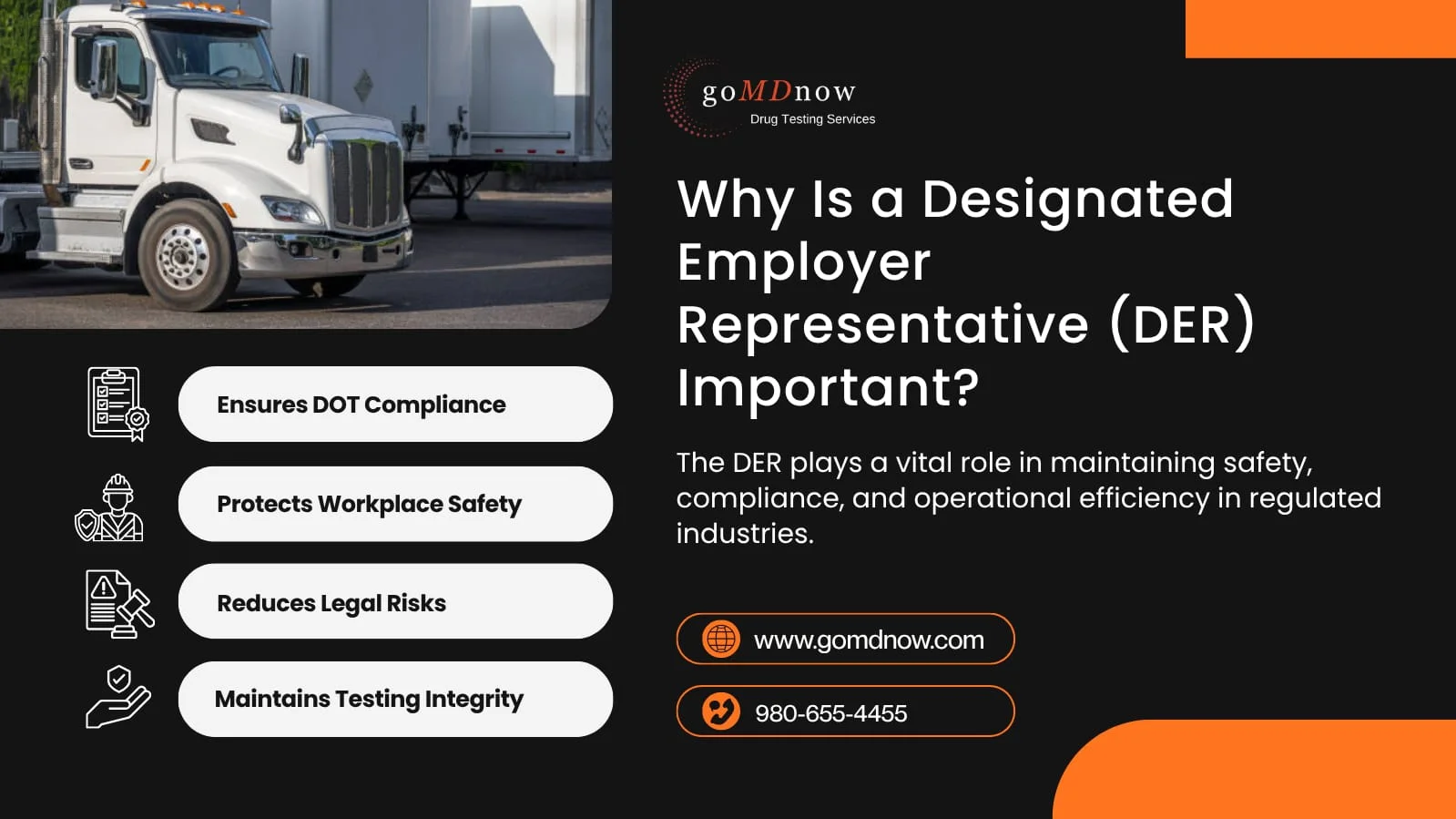
1. Ensures DOT Compliance
The DER ensures all drug and alcohol testing procedures follow federal DOT guidelines. A compliant DOT program requires a designated DER, a written drug and alcohol policy, an MRO relationship, and complete recordkeeping — the DER is the thread that holds all of this together.
2. Protects Workplace Safety
By managing testing programs, the DER helps prevent impaired individuals from performing safety-sensitive duties.
3. Reduces Legal Risks
Proper handling of test results reduces the risk of fines, lawsuits, and regulatory violations. See the most costly compliance failures that result from poorly managed testing programs.
4. Maintains Testing Integrity
The DER ensures that random testing and other procedures are conducted fairly and correctly.
5. Supports Operational Efficiency
A well-managed testing program minimizes disruptions and keeps operations running smoothly.
Key Responsibilities of a DER
1. Managing DOT Drug and Alcohol Testing Programs
The DER is responsible for overseeing all federally required testing types including pre-employment testing, random testing, post-accident testing, reasonable suspicion testing, return-to-duty testing, and follow-up testing. Each must be conducted according to DOT procedures, and the DER ensures proper scheduling and compliance.
2. Receiving and Managing Test Results
One of the most critical duties is handling confidential test results — negative results, non-negative results requiring MRO review, and verified positive results. The DER must act immediately upon receiving results, especially involving safety-sensitive employees. Missed random selections, delayed post-accident testing, and incomplete Clearinghouse queries are the most common audit findings in DOT-regulated employer programs.
3. Coordinating With Medical Review Officers (MROs)
The DER works closely with the MRO to confirm test outcomes, provide employee information when required, receive verified results, and ensure proper documentation. This coordination ensures accuracy and fairness — including situations where a prescription medication may explain a non-negative result.
4. Handling Positive Drug or Alcohol Tests
When an employee tests positive, the DER must take immediate action including removing the employee from safety-sensitive duties, documenting the violation, referring the employee to a SAP, following return-to-duty procedures, and ensuring follow-up testing compliance. The violation must also be reported to the FMCSA Drug and Alcohol Clearinghouse. Failure to act promptly can result in serious compliance violations.
5. Managing Random Testing Programs
Random testing is a core DOT requirement. The DER ensures employees are selected randomly, testing rates meet federal requirements, selections remain confidential, and tests are completed within required timeframes. Learn more about how frequently random drug and alcohol testing is required by DOT agency.
6. Recordkeeping and Documentation
The DER must maintain drug and alcohol test results, chain-of-custody forms, random selection lists, employee testing history, SAP and return-to-duty documentation, and compliance audit records. These records are essential during DOT audits and inspections.
7. Communication With Service Providers
The DER acts as liaison between the employer and all service providers. Effective communication ensures timely and accurate processing of all testing-related activities — and ensures the DER (not the service agent) retains final decision-making authority.
Who Can Be a Designated Employer Representative?
A DER must be an employee of the company — someone with direct authority to make immediate decisions regarding employee testing and compliance. Common DER roles include company owners, safety managers, HR managers, operations managers, and compliance officers.
In small companies or owner-operator businesses, the owner often serves as the DER. The October 2025 DOT ODAPC Employer Guidelines specifically recommend designating more than one DER to ensure coverage on all shifts and at all locations — so someone with proper authority is always available when a testing situation arises. This is especially important for leased owner-operators and small fleets — see DOT requirements for leased owner-operators for more context on compliance responsibilities.
Who cannot be a DER: Service agents — including C/TPAs, MROs, collectors, laboratories, and SAPs — cannot serve as the DER. Even if a company uses a C/TPA to manage its testing program, the DER must still be an internal company employee. Enrolling in a TPA does not transfer DER responsibilities to the third party.
DOT-Regulated Industries That Require a DER
A DER is required in all industries regulated by the U.S. DOT, including FMCSA (commercial trucking and buses), FAA (aviation), FRA (railroads), FTA (public transit), PHMSA (pipelines and hazardous materials), and USCG (maritime operations). Every organization falling under DOT regulations that employs safety-sensitive employees must have at least one qualified DER.
2026 Updates DERs Must Know
The DER role is evolving with several important 2026 regulatory developments:
- Oral fluid testing authorized — DOT authorized oral fluid as an alternative to urine effective December 5, 2024. DERs should begin updating policies and procedures now. Once HHS-certified labs are operational, oral fluid specimens can be collected under direct observation — eliminating substitution risk. Implementation timing depends on at least two labs being certified
- Electronic recordkeeping expansion — the shift toward eCCF and digital records means DERs must ensure their documentation systems support electronic chain-of-custody forms and secure audit-ready storage
- Fentanyl panel addition pending — DOT's NPRM to add fentanyl to the 5-panel is expected to finalize in early 2026. DERs should prepare to update written policies and communicate changes to employees
- Clearinghouse CDL downgrades — as of November 2024, unresolved Clearinghouse violations trigger automatic CDL downgrades. DERs must ensure all violations are reported and resolved through the full return-to-duty process
Skills Required for an Effective DER
An effective DER should have strong understanding of DOT regulations, excellent organizational abilities, attention to detail, confidentiality and ethical handling of data, decision-making authority, and communication and coordination skills. Proper training is highly recommended to ensure accuracy and compliance.
Common Mistakes Made by DERs
- Delaying removal of employees after positive results — this must happen immediately
- Poor recordkeeping and documentation
- Incorrect random testing procedures — especially mixing DOT and non-DOT employees in the same pool
- Assuming the C/TPA or service agent carries the DER responsibility — they cannot
- Failure to communicate with MROs or SAPs promptly
- Incomplete follow-up testing programs
- Not verifying that employees using hemp or CBD products understand the testing risk — see can you fail a drug test after using hemp products
Benefits of Having a Trained DER
Having a trained DER provides improved compliance with all DOT regulations, increased workplace safety by reducing impaired employees in safety-sensitive roles, better organization of testing and compliance records, reduced legal exposure, and efficient testing program coordination.
Why Small Businesses Need a DER
DOT regulations apply to all covered employers regardless of size. In small trucking companies or owner-operator setups, the business owner usually acts as the DER. Even a single mistake in testing procedures can result in serious consequences for small operations. Learn why small fleets fail compliance more often and how to avoid the most common pitfalls.
How goMDnow Supports DERs and Employers
Many businesses rely on professional support services to manage DOT compliance. goMDnow assists Designated Employer Representatives and employers by offering DOT drug and alcohol testing services, random testing consortium management, compliance program setup, testing coordination and scheduling, documentation and reporting support, and guidance on DOT regulations.
With goMDnow, employers can simplify compliance, reduce administrative burden, and ensure their drug and alcohol testing programs are fully aligned with DOT requirements. Explore our nationwide testing network, review our drug testing pricing, or contact us today.
Conclusion
The Designated Employer Representative (DER) is one of the most important roles in any DOT-regulated organization. From managing drug and alcohol testing programs to handling sensitive results and ensuring regulatory compliance, the DER plays a crucial role in workplace safety and legal protection.
A well-trained DER helps companies avoid penalties, maintain operational efficiency, and ensure that employees are fit for safety-sensitive duties. In today's strict regulatory environment — with oral fluid testing authorized, fentanyl panel changes pending, and Clearinghouse CDL downgrades enforced — having a knowledgeable, properly designated DER is not just recommended. It is essential.
Frequently Asked Questions (FAQs)
1. What is a Designated Employer Representative (DER)?
A DER is the employee authorized by the employer to take immediate action to remove employees from safety-sensitive duties and manage the company's DOT drug and alcohol testing program under 49 CFR Part 40.
2. Who can be a DER?
A company owner, HR manager, safety officer, or authorized employee can serve as a DER — but it must be an internal employee. Service agents such as C/TPAs, MROs, laboratories, and collectors cannot serve as the DER.
3. Is a DER required for DOT compliance?
Yes. Every DOT-regulated employer must have at least one designated DER. The October 2025 DOT ODAPC guidelines recommend having more than one DER for coverage across all shifts and locations.
4. What does a DER do after a positive drug test?
The DER immediately removes the employee from safety-sensitive duties, documents the violation, reports it to the FMCSA Clearinghouse, refers the employee to a SAP, and coordinates the return-to-duty process.
5. Does a DER need training?
Yes. Training is strongly recommended — and increasingly considered a best practice requirement. The DER must understand 49 CFR Part 40 in detail, including their specific mode's regulations, to make real-time decisions correctly.