
For CDL drivers and DOT-regulated employers, drug and alcohol testing is not just a workplace policy it is a federal safety requirement. The U.S. transportation industry operates under strict compliance standards to protect public safety, reduce accidents, and ensure professional accountability.
If you are a commercial driver, one failed or refused DOT drug test can significantly impact your career. Many drivers worry:
- Will I lose my job?
- Will my CDL be suspended?
- Can I ever drive again?
- Does this go on my permanent record?
Understanding the consequences of a failed DOT drug test and knowing the Return-to-Duty (RTD) process can help you respond correctly and protect your livelihood. This guide explains everything in clear, practical terms.
What Is a DOT Drug Test?
A DOT drug test is a federally regulated test required for safety-sensitive transportation employees. For commercial motor vehicle drivers, testing is governed by the Federal Motor Carrier Safety Administration (FMCSA).
These tests are mandatory in several situations:
- Pre-employment
- Random testing see how frequently random drug and alcohol testing is required
- Post-accident
- Reasonable suspicion
- Return-to-duty
- Follow-up testing
The purpose of DOT drug testing is simple: to prevent impaired driving and ensure public road safety.
What Drugs Are Tested?
DOT urine drug tests screen for five major drug categories under the standardized DOT 5-panel drug test:
- Marijuana (THC) learn how long marijuana stays in your system
- Cocaine what to know about cocaine drug testing
- Amphetamines (including methamphetamine) what AMP means on a drug test
- Opioids (Hydrocodone, Hydromorphone, Oxycodone, Oxymorphone) see expanded opioid drug testing
- Phencyclidine (PCP) what you need to know about PCP testing
All testing is conducted through SAMHSA-certified laboratories and verified by a Medical Review Officer (MRO).
What Makes You Fail a DOT Drug Test?
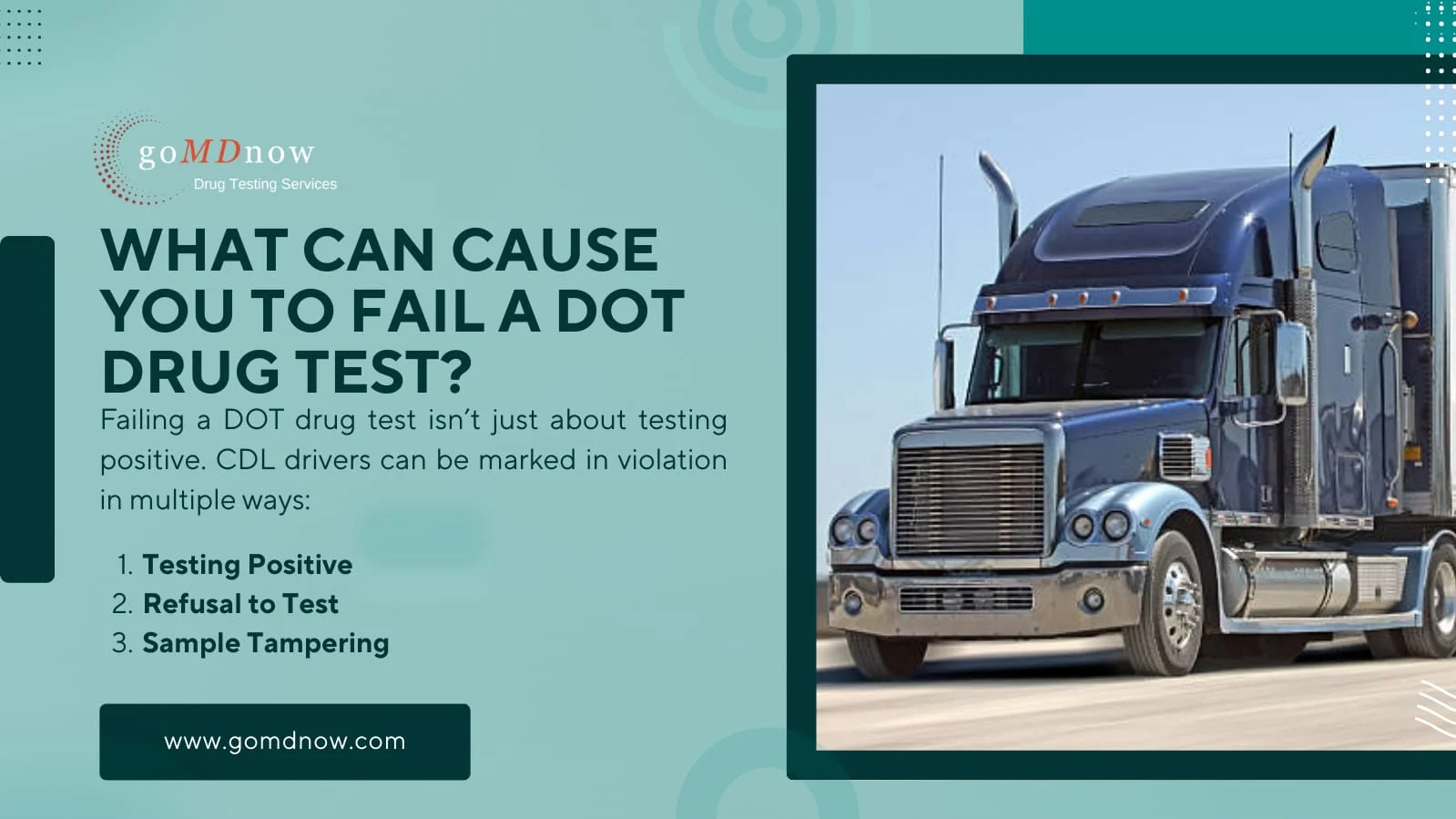
Failing a DOT drug test does not only mean testing positive. You can fail in several ways:
1. Testing Positive
If prohibited substances exceed DOT cutoff levels, the MRO verifies the result as positive.
2. Refusal to Test
A refusal is treated exactly like a failed test. This includes:
- Not appearing for a scheduled test
- Leaving before completion
- Not providing sufficient specimen understand shy bladder rules in DOT drug testing
- Tampering or adulterating a sample
- Refusing to cooperate
3. Sample Tampering
Attempting to manipulate the sample automatically results in a violation. Learn about how the DOT chain of custody protects sample integrity.
Prescription Medication & False Positives
If you have a valid prescription, the MRO will verify it. You may also request a split-sample retest within 72 hours of notification if you believe there is a false positive result.
It is also important to note that marijuana's legalization in some states does not exempt it from DOT testing requirements. A positive marijuana result is still a DOT violation regardless of state law or a medical prescription.
What Happens If You Fail a DOT Drug Test?
Failing a DOT drug test leads to immediate regulatory consequences.
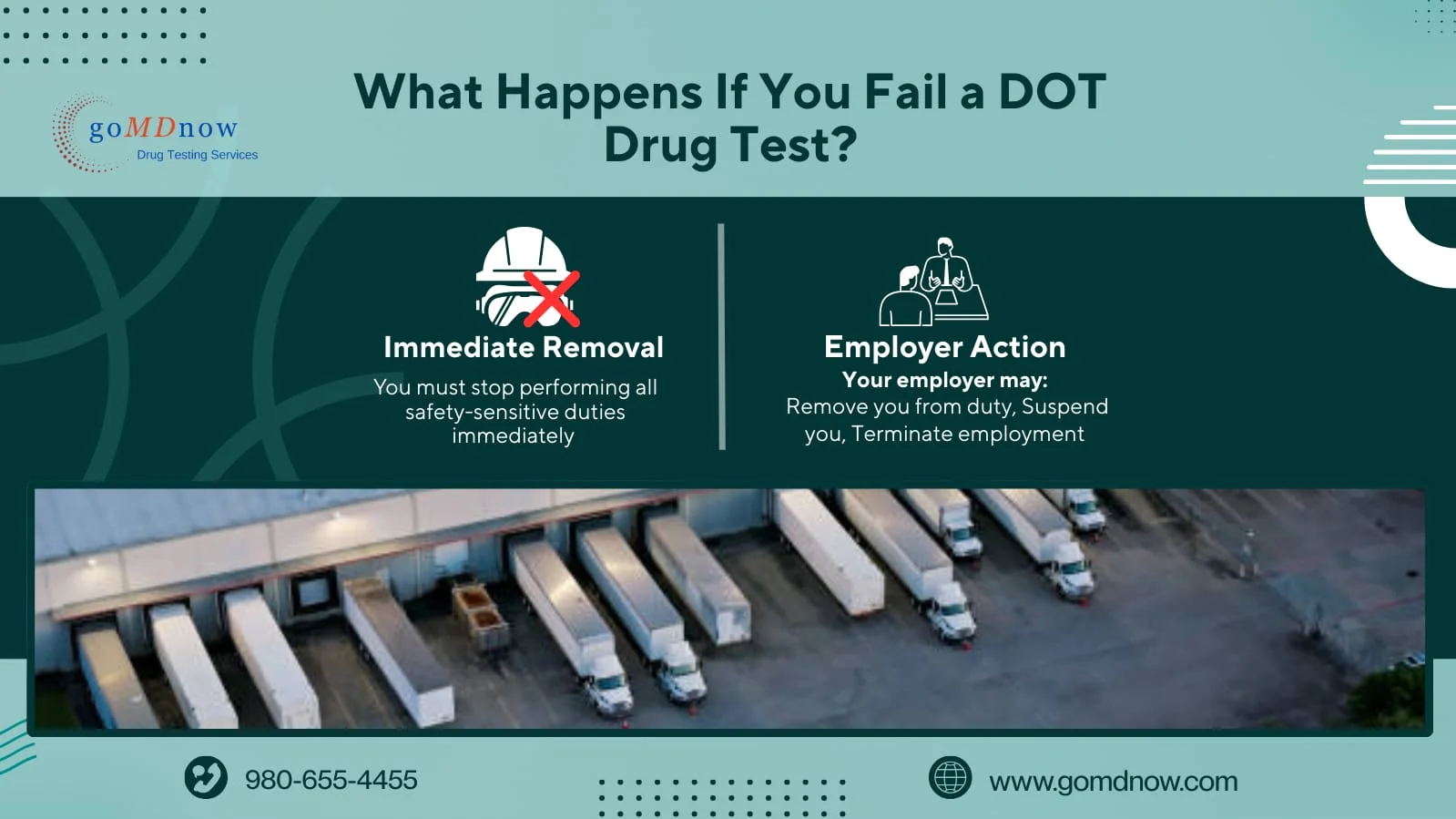
Immediate Removal from Safety-Sensitive Duties
You must stop operating a commercial vehicle immediately. Review DOT rules and regulations you can't afford to ignore.
Employer Action
Your employer may:
- Remove you from duty
- Suspend you
- Terminate employment
DOT requires removal from safety-sensitive duties but does not require automatic termination. Employers must follow the correct compliance procedures when handling a positive result.
FMCSA Clearinghouse Reporting
Your violation is recorded in the FMCSA Drug and Alcohol Clearinghouse. All DOT-regulated employers must check this database before hiring and annually for existing drivers. This means a violation will be visible to any future employer running a Clearinghouse query.
Will You Be Arrested?
In most situations, failing a DOT drug test does not result in arrest. It is a compliance violation, not a criminal charge. However, if drugs are found during a roadside inspection or other law enforcement action, criminal charges may apply separately. Understand what qualifies as a DOT violation.
Can Your CDL Be Suspended?
Yes. If you fail or refuse a DOT drug test and do not begin the Return-to-Duty process, your CDL may be downgraded, suspended, or marked ineligible by your State Driver Licensing Agency (SDLA). This is the result of full integration between the FMCSA Clearinghouse and state CDL systems unresolved violations now trigger automatic CDL downgrades. Learn more about how to stay DOT compliant and avoid this outcome.
You cannot legally drive a commercial motor vehicle until compliance is completed.
The Return-to-Duty (RTD) Process
A failed DOT drug test does not permanently end your driving career. There is a structured reinstatement process. Here is every step you must complete:
Step 1: SAP Evaluation
You must meet with a qualified Substance Abuse Professional (SAP). The SAP assesses your situation and recommends an appropriate education or treatment plan.
Step 2: Complete Recommended Treatment
Follow the education or treatment plan fully. The SAP determines what is required skipping or partially completing treatment will disqualify you from reinstatement.
Step 3: Return-to-Duty Test
You must pass an observed DOT drug test administered under direct supervision. This test cannot be self-scheduled it must be coordinated through a compliant testing provider.
Step 4: Follow-Up Testing
You will be subject to unannounced DOT follow-up tests for 12 to 60 months as determined by the SAP. Only after completing all these steps can you legally resume safety-sensitive duties.
How Long Does a Failed DOT Drug Test Stay on Record?
A DOT violation remains in the Clearinghouse for:
- Five years, OR
- Until the Return-to-Duty process is fully completed whichever comes first
This record is visible to all DOT-regulated employers who run a Clearinghouse query during the pre-employment process or annual checks. It directly affects your ability to be hired as a CDL driver. See DOT requirements for truck drivers to understand what employers are looking for.
How to Get Back on the Road
If you fail a DOT drug test, act immediately:
- Register in the Clearinghouse
- Start the SAP evaluation process
- Complete all required education or treatment
- Pass the Return-to-Duty test
- Comply with follow-up testing requirements for the full duration set by your SAP
Working with an experienced DOT compliance service provider can make this process smoother and ensure all federal requirements are met. A qualified third-party administrator (C/TPA) can guide both drivers and employers through each step.
goMDnow provides nationwide DOT drug testing services and assists CDL drivers and employers with Return-to-Duty coordination, SAP referrals, and Clearinghouse compliance management. Explore our drug testing pricing or find a testing center near you.
Frequently Asked Questions (FAQs)
1. Can I retake a DOT drug test right away?
No. You must complete the SAP evaluation and recommended treatment before taking a Return-to-Duty test. Learn more about what to expect from the Return-to-Duty drug test.
2. Does a refusal count as a failed drug test?
Yes. A refusal is treated the same as a positive result and must be reported to the FMCSA Clearinghouse. This includes no-shows, incomplete tests, and sample tampering.
3. Is a failed DOT drug test permanent?
No. You can regain eligibility after completing the required Return-to-Duty steps. The violation remains in the Clearinghouse for five years or until RTD is complete.
4. Can I drive for a different company while my violation is unresolved?
No. Because the violation is recorded in the FMCSA Clearinghouse, any DOT-regulated employer will see it during their mandatory pre-employment query and cannot legally hire you for a safety-sensitive position until RTD is complete.
5. Do employers have to report my failed test to the Clearinghouse?
Yes. Reporting to the Clearinghouse is a federal requirement for all DOT-regulated employers. Failure to report is itself a DOT Clearinghouse violation that can result in penalties.
Final Thoughts
Failing a DOT drug test is a serious matter that can temporarily remove you from driving and place your CDL at risk. It affects your employment, your record in the FMCSA Clearinghouse, and your future job opportunities. However, it is not necessarily the end of your career.
The DOT system is built around safety and accountability, but it also provides a structured path for rehabilitation and reinstatement. The key is acting quickly, understanding the Return-to-Duty process, and complying fully with SAP recommendations and follow-up testing.
For CDL drivers, staying informed about DOT drug testing rules protects your license and your income. For employers, maintaining strict compliance including proper Clearinghouse reporting and working with a DOT random testing consortium safeguards your operating authority and prevents costly violations.
If you are facing a DOT drug test violation, take proactive steps immediately. Contact goMDnow today compliance now ensures you can legally and confidently return to the road tomorrow.