
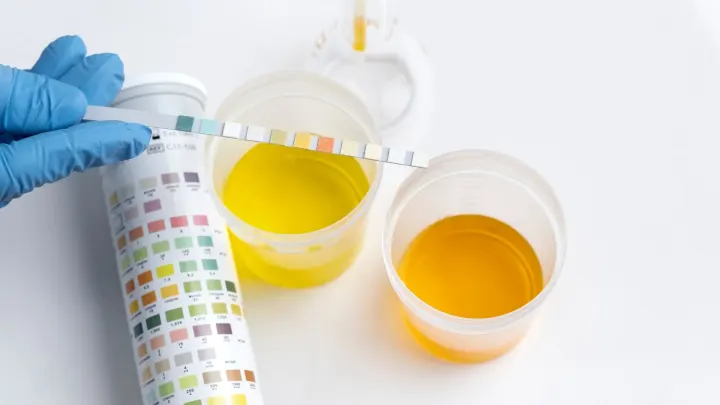
Synthetic urine, also known as fake urine, is a laboratory-made liquid designed to imitate the chemical composition of real human urine. It is commonly marketed online as a way to cheat drug tests including those mandated by the U.S. Department of Transportation (DOT). The use of synthetic urine poses a serious risk to public safety, especially in the trucking industry where drug-free operation of commercial motor vehicles is a federal legal requirement.
The short answer is: yes synthetic urine can and frequently is detected in modern drug tests. But understanding how it is detected, and what happens when it is, is what every CDL driver and employer needs to know.
What Is Synthetic Urine?
Synthetic urine is a premixed or powdered chemical solution formulated to replicate the physical and chemical properties of real human urine. It typically contains:
- Urea and uric acid
- Creatinine
- Phosphates, chlorides, and sulfates
- Balanced pH and specific gravity
- Yellow coloring to match the appearance of real urine
While some synthetic products are formulated specifically to mimic the chemical fingerprint of human urine, certified drug testing laboratories have significantly advanced their detection capabilities. As detection methods improve year over year, synthetic urine products that may have avoided detection in the past are increasingly flagged by current laboratory procedures.
Does Synthetic Urine Actually Work to Pass a Drug Test?
Synthetic urine products are often marketed with bold claims about passing drug tests. The reality is more complicated and the risk is far greater than most people realize.
Whether synthetic urine "works" depends entirely on the testing method used and the diligence of the collection and laboratory process. For casual non-DOT testing with minimal oversight, some products have historically slipped through. However, for any DOT-regulated test conducted at a SAMHSA-certified laboratory, the answer is different labs are specifically required to run specimen validity testing (SVT) on every sample, making detection of synthetic urine highly likely.
Can a DOT Drug Test Detect Synthetic Urine?
Yes. DOT regulations mandate that all certified drug testing laboratories screen urine samples for signs of adulteration or substitution as part of every test this is called Specimen Validity Testing (SVT). SVT is run before the drug panel analysis, meaning that even if a sample contains no detectable drugs, it can still be flagged and reported as a violation based on SVT results alone.
Labs evaluate the following markers to identify synthetic or tampered samples:
1. Temperature Check
This is the first and fastest check. Fresh human urine must fall within 90–100°F (32–38°C) at the moment of collection. Collectors verify temperature within minutes of submission using a temperature strip on the collection cup. A sample outside this range is immediately flagged as suspicious and may require an observed recollection on the spot.
2. Creatinine Levels
Creatinine is a natural waste product produced by muscles and always present in authentic human urine. Labs measure creatinine concentration levels below 2 mg/dL combined with a specific gravity of ≤1.0010 or ≥1.0200 indicate a substituted specimen. Many synthetic urine products contain insufficient creatinine or produce concentrations outside normal physiological ranges.
3. pH Balance
Human urine normally has a pH level between 4.5 and 8.0. Readings outside this range indicate the sample may be adulterated or synthetic. Labs use both dipstick testing and chemical analysis to verify pH against the accepted range.
4. Specific Gravity
Specific gravity measures the concentration of dissolved substances in the sample. Real human urine typically falls between 1.005 and 1.030. Synthetic urine often fails to accurately replicate the natural biological variation found in human samples, and readings outside the expected range flag the specimen as substituted.
5. Oxidant and Adulterant Screening
Labs also test for oxidizing agents, nitrites, glutaraldehyde, bleach, and other common masking agents sometimes added to urine or synthetic products to interfere with drug immunoassay results. Their presence is itself grounds for reporting an adulterated specimen.
6. GC-MS / LC-MS/MS Confirmatory Analysis
When a sample raises red flags during initial SVT, labs escalate to advanced confirmatory testing using Gas Chromatography-Mass Spectrometry (GC-MS) or Liquid Chromatography-Mass Spectrometry (LC-MS/MS). These methods identify the full chemical composition of a sample including the absence of biological compounds naturally present in human urine that cannot be replicated by any synthetic product. As of 2024–2025, some certified labs have also integrated AI-assisted pattern recognition to identify non-physiologic chemical signatures that differ from authentic human samples.
7. Chain of Custody and Visual Inspection
Collectors conduct visual inspection of the sample's color, clarity, foam, and odor at the point of collection. The strict chain of custody process ensures sample integrity from collection through laboratory analysis, making tampering at any stage detectable.
Substituted, Adulterated, and Invalid What Each Means
When SVT flags a sample, the lab assigns one of three result types each with different consequences:
Substituted: Creatinine and specific gravity are outside the ranges consistent with normal human physiology. The sample is not consistent with normal human urine. Under DOT rules, this is reported as a refusal to test.
Adulterated: The specimen contains a foreign substance not expected in human urine, or pH falls outside 3.0–11.0. Also reported as a refusal to test under DOT regulations.
Invalid: The specimen produces an unresolvable result that prevents valid drug testing. Under DOT rules, an invalid result triggers a mandatory direct-observation recollection no advance notice given.
The Medical Review Officer (MRO) reviews all flagged SVT results and makes the final determination on how the result is reported to the employer and the Clearinghouse.
DOT Consequences for Using Synthetic Urine
For CDL drivers and DOT-regulated employees, submitting synthetic urine is among the most serious drug testing violations possible. Under 49 CFR §40.191(b), a verified substituted or adulterated specimen is treated as a refusal to test which carries the same consequences as a confirmed positive result, or worse.
- Immediate removal from safety-sensitive functions the driver cannot operate a CMV from the moment the result is reported
- Reported to the FMCSA Drug and Alcohol Clearinghouse permanently recorded and visible to all future DOT-regulated employers. See how Clearinghouse violations affect your CDL career
- CDL downgrade or suspension as of November 18, 2024, unresolved Clearinghouse violations trigger automatic CDL downgrades through full SDLA integration
- Mandatory Return-to-Duty process the driver must complete a full SAP evaluation, education or treatment program, and pass a return-to-duty drug test before resuming any safety-sensitive duties
- Follow-up testing program minimum 6 unannounced follow-up tests over the first 12 months, potentially extending up to 60 months
- Cannot work for any DOT-regulated employer until the full Return-to-Duty process is complete
Unlike a positive drug test, a refusal-to-test designation cannot be overturned by arbitration, grievance, or any non-federal forum. It is among the most permanent violations in a CDL driver's record.
Is Using Synthetic Urine Illegal?
Beyond the professional consequences, using synthetic urine to defraud a drug test is a criminal offense in many states. As of 2026, more than 18 states have specific legislation making it illegal to sell, use, or distribute synthetic urine with intent to defraud a drug screening including Florida, New Jersey, Mississippi, Virginia, and California (Health & Safety Code §24135, enacted 2024). Penalties range from fines to years in prison depending on the state. Even in states without specific laws, broader fraud and obstruction statutes may apply.
DOT Practices That Prevent Synthetic Urine Use
DOT regulations and certified testing programs include multiple layers of protection against sample fraud:
- Direct observation collections required for return-to-duty, follow-up testing, and any situation where a specimen is flagged as invalid or outside temperature range
- Random drug testing and scheduling unannounced selections through a DOT random testing consortium give no opportunity to prepare a substituted sample
- SAMHSA-certified laboratories mandatory for all DOT testing; these labs are required to run full SVT on every specimen
- Strict chain of custody procedures the DOT chain of custody form (CCF) tracks every sample from collection to result
- Supervisor and employee training on recognizing and reporting suspicious behavior during testing
- Post-accident drug testing conducted promptly after qualifying incidents, limiting the window to obtain and use a substituted sample
- Oral fluid testing option the DOT's May 2023 rule permitting saliva-based collection eliminates substitution entirely, as oral fluid is collected under direct observation
Tips for Trucking Companies to Protect Their Testing Program
- Partner with a reputable C/TPA or certified drug testing clinic that uses SAMHSA labs and full SVT
- Maintain a written DOT drug and alcohol testing policy and keep it updated
- Implement employee drug education and awareness programs including the consequences of sample fraud
- Conduct reasonable suspicion testing when supervisors observe signs of impairment or suspicious behavior
- Run Clearinghouse queries before every new CDL hire to catch prior violations
- Encourage employees to report suspected drug use or tampering attempts
Frequently Asked Questions (FAQs)
1. Can a DOT drug test detect synthetic urine?
Yes. DOT-mandated tests at SAMHSA-certified labs include specimen validity testing (SVT) on every sample. SVT checks temperature, creatinine, pH, specific gravity, and adulterants before the drug panel is even run. Advanced confirmatory methods like GC-MS can further identify missing biological markers unique to authentic human urine.
2. What drugs does a DOT 5-panel drug test screen for?
The DOT 5-panel drug test screens for Marijuana (THC), Cocaine, Amphetamines, Opioids, and PCP verified against federally mandated cutoff levels.
3. What happens to a CDL driver caught submitting synthetic urine?
The result is reported as a refusal to test under 49 CFR §40.191(b) same as a positive. The driver is immediately removed from safety-sensitive duties, the violation is reported to the FMCSA Clearinghouse, the CDL may be downgraded, and the driver must complete the full Return-to-Duty process before working for any DOT-regulated employer.
4. What is the difference between substituted, adulterated, and invalid?
A substituted specimen has creatinine and specific gravity inconsistent with human physiology. An adulterated specimen contains foreign masking substances. An invalid specimen cannot be reliably tested. Under DOT rules, substituted and adulterated results are refusals to test. An invalid result requires a mandatory direct-observation recollection.
5. Is using synthetic urine illegal?
In 18+ states, yes with criminal penalties including fines and jail time. In other states, it may fall under fraud statutes. For DOT-regulated testing, it constitutes a federal regulatory violation regardless of state law.
6. What can I do if I believe my result is a false positive?
You have the right to request a split-specimen retest within 72 hours of MRO notification. See what causes false positive drug test results and how to address them through the MRO verification process.
Bottom Line
Synthetic urine may seem like a shortcut, but it is not a reliable or ethical solution and the consequences of detection are severe and permanent. With mandatory specimen validity testing, advanced GC-MS confirmation, direct observation protocols, and the FMCSA Clearinghouse permanently recording violations, the risk far outweighs any perceived benefit.
The best approach is simple: maintain a drug-free lifestyle. For CDL drivers and safety-sensitive employees, no drug test outcome is worth a career-ending Clearinghouse violation, CDL downgrade, and criminal exposure.
goMDnow provides nationwide DOT and non-DOT drug testing services through a network of 20,000+ certified testing centers. Whether you need a single test or a complete compliance program, explore our drug testing pricing or contact us today.