

How Should Employers Choose a C/TPA?
When choosing a C/TPA, compare regulatory knowledge, collection site coverage, random pool management, Clearinghouse support, MRO and lab arrangements, record access and price. A good C/TPA keeps your roster current, makes compliant random selections, tracks completion, and can produce audit records quickly. The employer stays responsible for compliance, so name an internal Designated Employer Representative (DER) and check the C/TPA's work (49 CFR § 40.15).
- Coverage: collection sites near your drivers
- Random program: selections, notices and completion tracking
- Clearinghouse: C/TPA registered and designated in your account
- Records: fast access for audits; employer stays responsible
Choosing a Consortium/Third-Party Administrator (C/TPA) affects how your company organizes DOT drug and alcohol testing, communicates random selections and retrieves records. Employers should compare more than the annual membership fee. Regulatory knowledge, collection access, clearly assigned duties and responsive support all matter.
This guide explains what to ask before choosing a C/TPA for a trucking company, fleet or owner-operator business. Start with the services your operation needs, then request a written explanation of what the provider will handle.
In this article, you'll learn:
What Is a C/TPA?
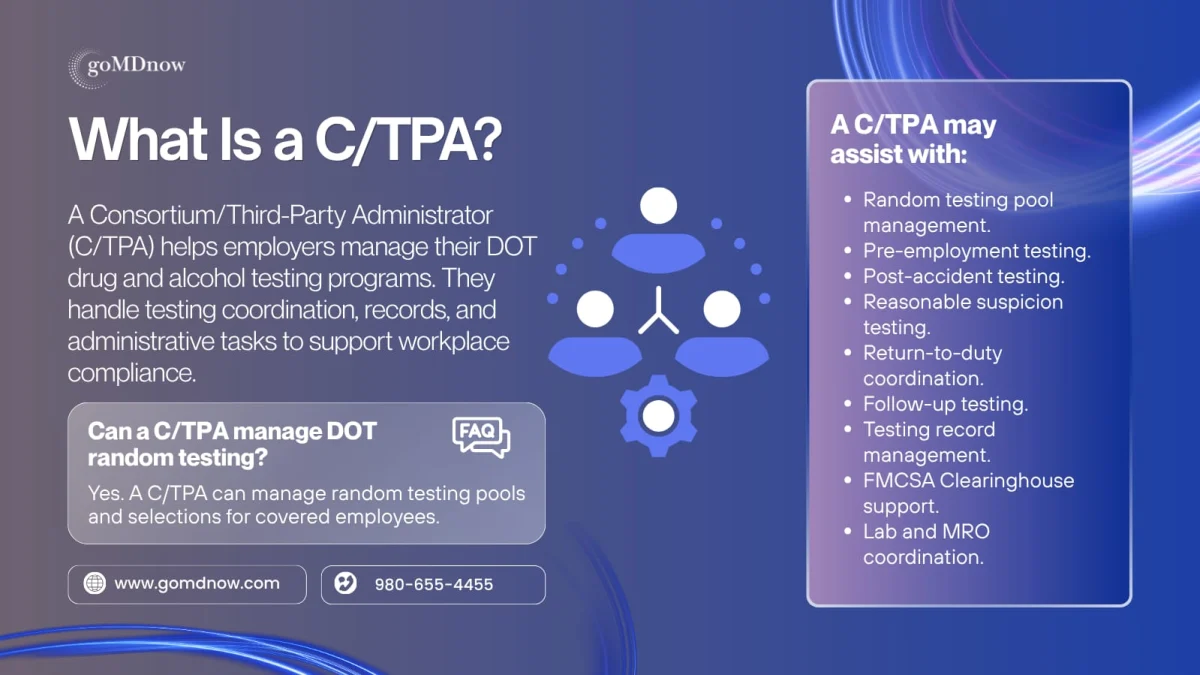
A C/TPA is a service agent that administers all or part of an employer's drug and alcohol testing program. Depending on the agreement, it may coordinate collections, administer a random testing pool, organize testing records and assist with authorized Clearinghouse activities.
For an overview of enrollment and random pool administration, see our DOT random testing consortium services. Consortium membership and Clearinghouse designation are separate steps that employers should confirm with their provider.
1. DOT and FMCSA regulatory knowledge
For an FMCSA-regulated motor carrier, the provider should understand both DOT testing procedures under 49 CFR Part 40 and the applicable employer requirements under Part 382. Ask how staff stay informed about rule changes and how they explain a collection problem, missed random test or reporting question.
Ask who performs each function and how the provider checks qualifications for collectors, laboratories and Medical Review Officers (MROs). Evaluate evidence of the qualifications required for the specific role rather than relying on a general claim that the company is "DOT certified." Under DOT rules, employers must ensure their service agents meet the applicable qualifications. Our guide to how laboratories protect specimen integrity explains the safeguards to discuss when evaluating testing partners.
2. Experience with your type of operation
A single-driver owner-operator business and a fleet with terminals in several states have different administrative needs. Ask whether the C/TPA supports operations similar to yours and request a demonstration of how it handles driver changes, test orders and collection instructions.
For an owner-operator, confirm both consortium enrollment and the separate requirement to designate a C/TPA in the FMCSA Clearinghouse. Review our Clearinghouse questions below before enrolling.
3. Collection locations and testing availability
A large network is useful only when the required service is available where your drivers travel. Ask about site hours, appointment requirements, rural access and which locations can perform the test you need. A site offering urine collections may have different availability for breath alcohol testing or directly observed collections.
Use the collection network information to plan access, and follow the authorization issued for each order. Confirm urgent or after-hours arrangements before an accident or other time-sensitive situation occurs.
4. Services for the full testing program
Confirm the provider can coordinate the testing reasons that apply to your operation. These may include pre-employment drug testing, random selections, qualifying post-accident testing and reasonable suspicion testing. Ask how requests are received and how the employer receives completion information.
When a driver has a DOT violation, return-to-duty requirements involve a separate process with a qualified Substance Abuse Professional (SAP). Follow-up testing is a distinct stage based on the SAP's plan. Confirm the provider's coordination role and what the employer must do at each stage.
5. Random pool administration
Ask how employees enter and leave the pool, how selections are made and how the administrator documents notifications and completed tests. A scientifically valid selection process and accurate driver information are the core of good program administration.
Confirm who updates the roster when drivers join, leave or change duties. Request clear instructions for a selection received while a driver is traveling. Review what happens when a driver is out of state during a random selection to identify practical questions for the provider. The employer should understand what happens when a selected employee is unavailable and how the situation is documented.
6. Clearinghouse authorization and responsibilities
Ask exactly which queries or reports the C/TPA will perform, what authorization is needed and how completion is documented. The provider must accept the employer's Clearinghouse designation before accessing the system on its behalf. Written terms should identify fees and tasks that remain with the employer.
Owner-operators registered as employers must designate a C/TPA for the required reporting role. Other tasks, including queries, depend on the authorization and agreement. Employers can also explore FMCSA Clearinghouse compliance training to understand their own responsibilities.
7. Recordkeeping, confidentiality and audit access
Ask which records are stored, how authorized users access them and how quickly they can be supplied for a compliance review. Request an explanation of retention practices, account permissions and the process for transferring records if you change providers.
The employer should know where required documents are held and how to obtain them. A provider's dashboard can support administration, but employers still need to confirm that required records are complete and available.
8. Transparent pricing and contract terms
Compare the total cost of the services you expect to use. Request an itemized explanation of membership, individual tests, observed collection, MRO review, Clearinghouse assistance and other administrative charges. Check renewal, cancellation and record-transfer terms.
Review the published service pricing, then confirm any costs specific to your operation. A low enrollment fee can be difficult to compare with a plan that includes different services.
9. Customer support and online tools
Test the support channels before committing. Ask how drivers receive instructions, who helps resolve an incorrect collection order and how quickly the employer can reach someone during business hours. Confirm the actual scope of after-hours support. Ask who will explain a drug test marked pending or under review and help the employee reach the appropriate contact.
For online tools, check roster management, test ordering, document access and user permissions. Ask for a walkthrough with realistic tasks so your team can judge how easily the system fits its workflow.
10. Capacity to grow with your business
Ask how the provider handles additional drivers, new terminals and changes in your testing needs. Confirm whether pricing, account access or administrative responsibilities change as the operation grows. Clear transition procedures can prevent gaps when you move from one administrator to another.
What Mistakes Do Employers Make When Choosing a C/TPA?
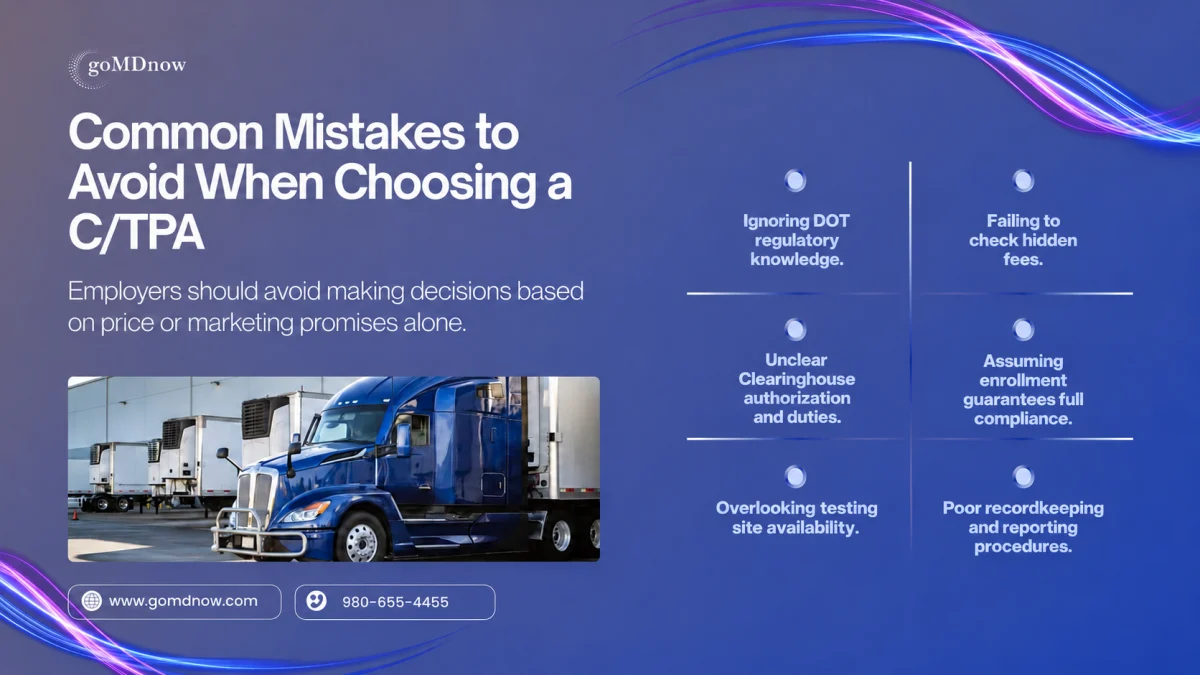
- Comparing membership fees without checking what is included.
- Assuming every listed collection site offers every testing service.
- Leaving Clearinghouse authorization and reporting duties unclear.
- Failing to confirm how required records can be retrieved.
- Assuming enrollment alone completes every employer requirement.
Under 49 CFR 40.15, an employer remains responsible for compliance when using a service agent. A service agent also cannot act as the employer's DER. Assign a person within your business to oversee the program and review the provider's work.
How Does goMDnow Support Employers as a C/TPA?
goMDnow coordinates DOT and non-DOT testing, consortium enrollment, return-to-duty and follow-up testing support, and related program administration. Employers can review the available services and contact goMDnow to discuss their operation, collection access and administrative needs before enrolling.
Frequently asked questions
What Does C/TPA Stand For?
C/TPA stands for Consortium/Third-Party Administrator. Its role depends on the services the employer has agreed to purchase and the functions allowed under the applicable rules.
Can a C/TPA manage DOT random testing?
Yes. A C/TPA can administer a random testing pool and coordinate selections. Employers should confirm roster updates, notifications, completion tracking and record access in writing.
Does enrollment make an employer fully compliant?
Employers remain responsible for the applicable DOT and FMCSA requirements. Review the agreement, assign an internal DER and verify that required activities are completed.
Is consortium enrollment the same as Clearinghouse designation?
They are separate activities. Confirm the provider's Clearinghouse registration, complete the required designation and agree on which authorized tasks it will perform.
How much does a C/TPA cost?
It depends on fleet size and services. At goMDnow, DOT consortium enrollment is $99.00 per year, and member drug tests are $79.95 when selected.
Sources
Reviewed by goMDnow DOT Compliance Specialists. goMDnow is an FMCSA-registered C/TPA serving employers and CDL drivers since 2019, with HHS-certified laboratory testing and Medical Review Officer (MRO) review.
This article is educational and is not medical or legal advice. Last updated: November 23, 2026