
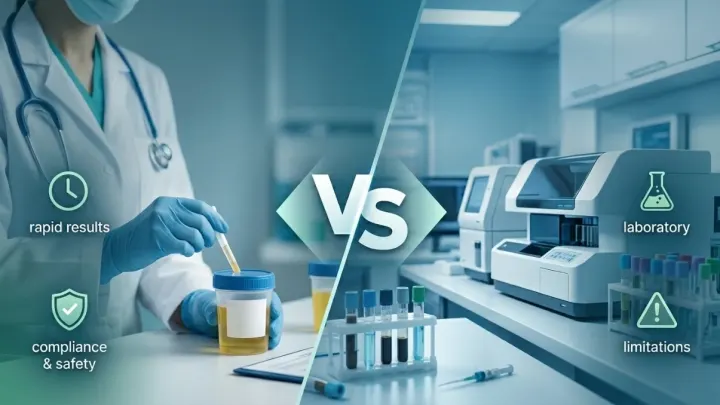
Drug testing plays a critical role in maintaining workplace safety, ensuring regulatory compliance, and protecting business operations. Many employers seek fast results to minimize hiring delays or respond quickly to workplace incidents. Point of Collection Testing (POCT), also known as instant or rapid drug testing, offers on-site screening with results in minutes but it comes with significant limitations that every employer must understand.
At goMDnow, we specialize in compliant, lab-based drug and alcohol testing for both DOT and non-DOT programs through our extensive nationwide network. While we do not offer POCT services, we frequently help employers evaluate whether rapid screening fits their needs or whether full laboratory testing provides better accuracy, defensibility, and compliance. Read on for a clear breakdown of POCT, its uses, and why many organizations ultimately choose lab-based solutions.
What Is Point of Collection Testing (POCT)?
Point of Collection Testing (POCT) refers to drug screening performed immediately at the collection site using instant test devices, rather than sending the specimen to a laboratory. The most common specimen is urine, though oral fluid (saliva) instant devices are also available in some settings.
These tests use disposable cups or strips that screen for multiple drug classes and deliver preliminary results within 5–10 minutes. POCT can serve as an initial screening tool for certain non-DOT workplace programs, but it is not a standalone solution for final decisions. Understand the full difference between lab-based vs. rapid drug testing to choose the right method for your program.
Critical Limitation: POCT Is NOT Permitted for DOT Testing
The most important point for any employer: Point-of-Collection (instant/rapid) testing is not permitted under U.S. Department of Transportation (DOT) regulations.
Under 49 CFR Part 40, all DOT-regulated drug testing for safety-sensitive positions must use urine or authorized oral fluid specimens sent to a SAMHSA-certified laboratory, with full chain-of-custody procedures, confirmation testing, and Medical Review Officer (MRO) review. This rule applies to pre-employment, random, post-accident, reasonable suspicion, return-to-duty, and follow-up testing.
goMDnow helps DOT-regulated employers stay fully compliant with lab-based testing programs, including random consortium management and FMCSA Clearinghouse reporting. Some states also impose restrictions on POCT even for non-DOT programs always verify local laws before implementing a rapid testing program.
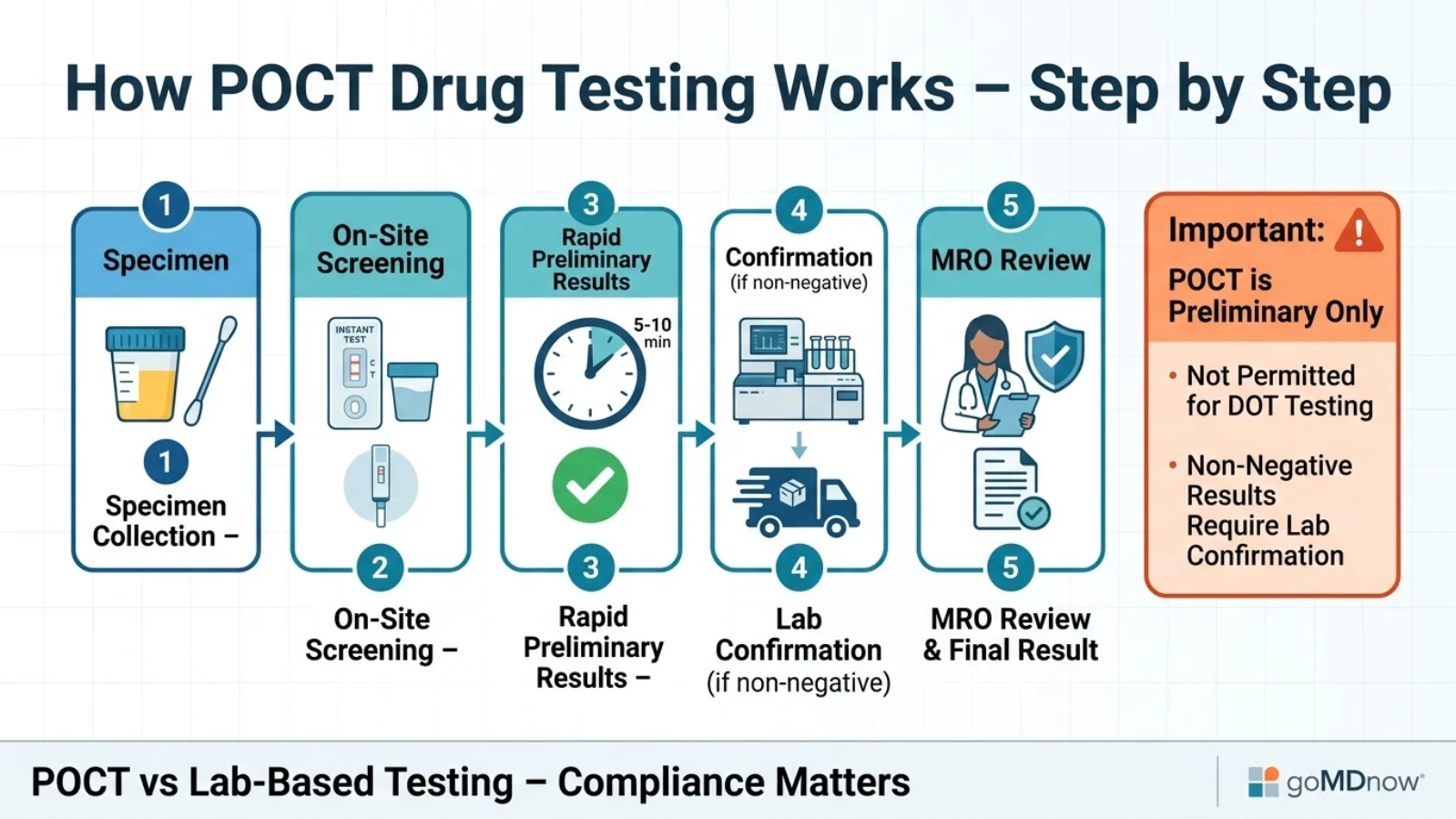
How Does a POCT Drug Test Work?
The typical POCT process includes these steps:
- Specimen Collection — The donor provides a urine or oral fluid sample on-site.
- On-Site Screening — The sample is immediately tested with an instant device.
- Preliminary Results — Negative results may appear within 5–10 minutes.
- Lab Confirmation if Needed — Any non-negative (preliminary positive) result must be sent to a certified laboratory for confirmatory testing (GC-MS or LC-MS).
- MRO Review — A qualified Medical Review Officer (MRO) reviews confirmed non-negative results before reporting to the employer.
This hybrid approach POCT screen plus lab confirmation for non-negatives aims to balance speed with accuracy, but it still requires proper handling and strict chain-of-custody procedures to maintain integrity.
Standard POCT vs. Instrumented POCT
POCT devices vary in reliability:
- Standard POCT — Uses visual color-change strips or cups. Results depend on human interpretation, which can introduce subjectivity or error.
- Instrumented POCT (iPOCT) — The device is read by a machine for objective, digitized results, offering greater consistency comparable to lab-based initial screening.
Even with instrumented devices, non-negative results require laboratory confirmation. Many employers also send a portion of negative POCT results for lab verification as a quality-control measure. Learn how specimen validity testing ensures sample integrity throughout the testing process.
Benefits and Limitations of POCT Drug Testing
Potential Benefits
- Speed: Negative results can be available the same day, helping accelerate hiring or operational decisions.
- Convenience: Testing can occur at job sites, offices, or collection centers with minimal disruption.
- Lower Initial Cost: Screening is cheaper than full lab testing for every sample lab work is reserved for non-negatives only.
Important Limitations
- Preliminary only non-negatives always require lab confirmation before any employment action.
- Not suitable for DOT programs or situations requiring fully defensible, MRO-verified results from the start.
- Potential for interpretation variability in standard (non-instrumented) devices.
- State-specific legal restrictions may apply some states restrict or prohibit POCT entirely.
- Does not include specimen validity testing (SVT) POCT devices cannot detect adulterated or substituted samples the way certified labs do.
For many employers, especially those with DOT obligations or high-stakes safety environments, the reliability and legal defensibility of full lab-based testing outweigh the speed advantage of POCT. Using non-DOT instant tests for CDL drivers is one of the most costly compliance mistakes trucking companies make and one that frequently surfaces during FMCSA audits.
Common Scenarios Where Employers Consider POCT
Some non-DOT organizations explore POCT for:
- Pre-employment screening (non-DOT roles only)
- Random testing in non-regulated positions
- Post-accident or reasonable suspicion testing (non-DOT only)
Note: POCT is not appropriate for return-to-duty or follow-up testing, where confirmed lab results are essential before an employee returns to safety-sensitive duties. goMDnow strongly recommends lab-based testing for any program where compliance, fairness, and legal protection are priorities.
What Drugs Can POCT Devices Typically Screen For?
Common panels detect substances such as:
- Marijuana (THC)
- Cocaine
- Opioids (morphine, codeine, oxycodone, hydrocodone)
- Amphetamines and methamphetamines
- Benzodiazepines
- PCP
- Barbiturates
- Methadone
Employers can select 5-panel, 10-panel, or expanded panels based on industry risks and company policy. Note that POCT devices do not detect Fen a specific Fen assay requires laboratory processing. See our guide on expanded opioid testing panels for broader coverage.
Accuracy Considerations
When used correctly with quality devices, POCT provides a reliable initial screen with high accuracy for true negatives. However, it remains a preliminary test. Any non-negative result must undergo laboratory confirmation and MRO review before any employment action is taken.
One important gap: standard POCT devices do not include specimen validity testing (SVT) meaning they cannot detect whether a sample has been adulterated, substituted, or diluted. Certified laboratories run SVT on every specimen before the drug panel analysis. Certified labs run SVT on every specimen as a standard part of the testing process. Also be aware that certain legal substances can cause unexpected results see whether nicotine or vaping products can cause false positive drug test results.
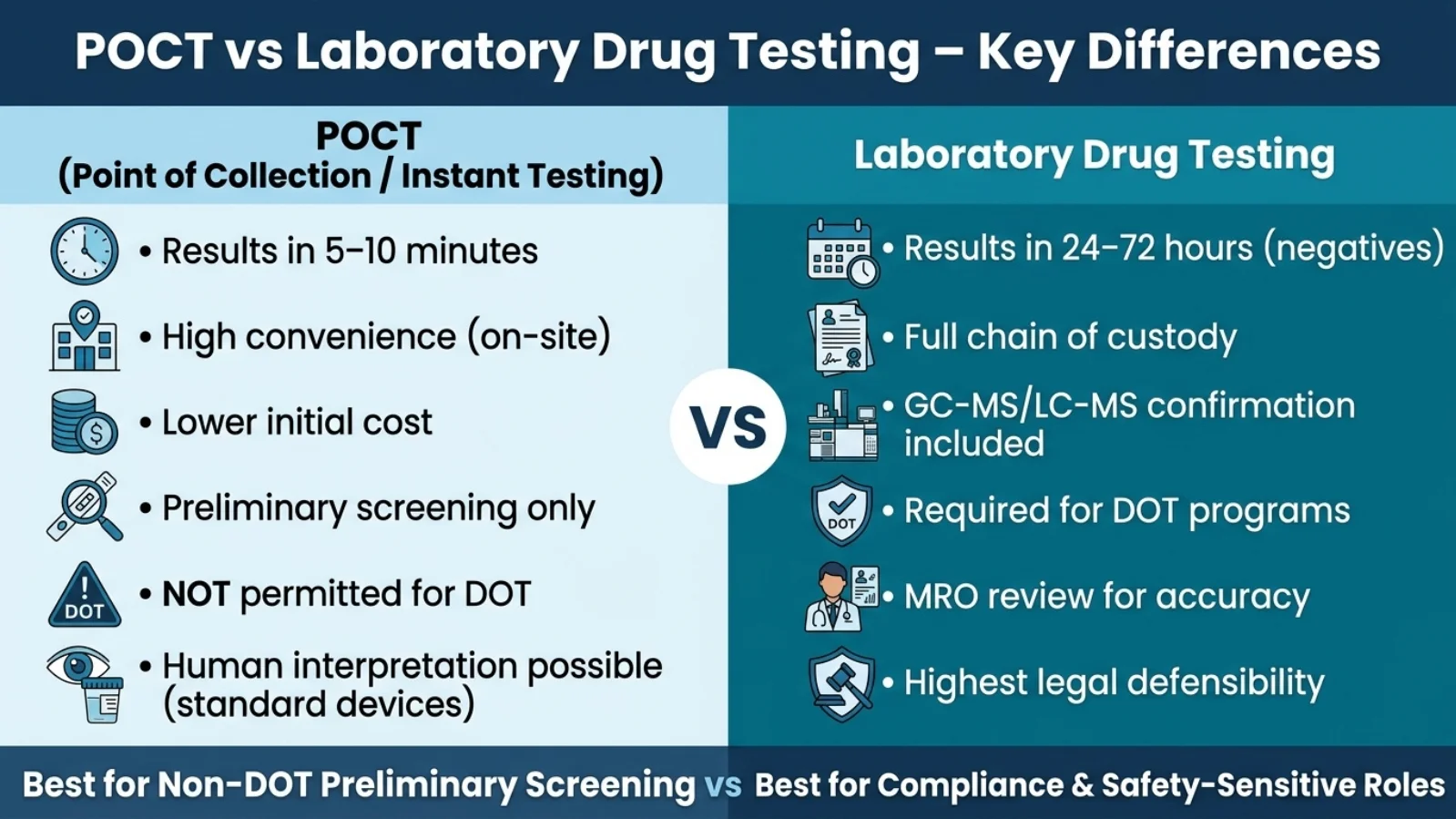
POCT vs. Laboratory Drug Testing
| Feature | POCT (Rapid/Instant) | Laboratory Drug Testing |
|---|---|---|
| Result Time | 5–10 minutes (preliminary) | 24–72 hours for negatives; 3–5 days for confirmed positives |
| Convenience | High (on-site possible) | Moderate (specimen collection + transport) |
| Cost Structure | Lower for initial screen | Higher per test but includes confirmation |
| Confirmation | Required for non-negatives | Included (GC-MS/LC-MS) |
| Specimen Validity Testing | Not included | Included on every sample |
| DOT Compliance | Not permitted | Required |
| Legal Defensibility | Limited until confirmed | High with full MRO review and chain of custody |
| Best Suited For | Non-DOT preliminary screening | DOT programs and any situation needing definitive results |
Many employers ultimately partner with a qualified C/TPA like goMDnow for seamless lab-based testing that ensures full compliance and reliable results across all scenarios.
Who Typically Needs Lab-Based Testing Instead of POCT?
goMDnow supports employers in industries such as:
- Transportation and logistics DOT-regulated roles where lab testing is mandatory
- Construction and manufacturing
- Healthcare and safety-sensitive positions
- Staffing agencies and government contractors
- Any organization maintaining a compliant drug-free workplace program
For DOT safety-sensitive employees, laboratory testing through SAMHSA-certified facilities is the only compliant option. Review the difference between DOT and non-DOT drug testing programs to confirm which applies to your workforce.
Best Practices for Drug Testing Programs
- Use trained collection personnel and maintain strict chain-of-custody procedures.
- Develop a clear, consistently applied written drug and alcohol testing policy.
- Ensure all non-negative results receive laboratory confirmation and MRO review before any employment action.
- Verify state-specific regulations before implementing any testing method.
- Partner with an experienced C/TPA or TPA for program management, especially for random testing consortia and return-to-duty processes.
Choosing the Right Testing Approach for Your Business
The best method depends on your industry, regulatory requirements, risk profile, and operational needs. goMDnow provides flexible, nationwide lab-based urine and hair drug testing, breath alcohol testing, random consortium management, and full compliance support. We help employers balance speed, cost, accuracy, and legal protection.
FAQs
1. How long does a POCT drug test take?
Preliminary negative results may appear in 5–10 minutes, but non-negative results require laboratory confirmation adding 1–3+ business days for the final verified result.
2. Is POCT allowed for DOT workplace testing?
No. DOT regulations (49 CFR Part 40) require SAMHSA-certified laboratory testing with MRO review for all covered employees. POCT, instant tests, and rapid tests are explicitly prohibited for any DOT testing event.
3. What happens if a POCT shows a non-negative result?
The specimen must be sent for laboratory confirmation. Only after MRO review can a final positive result be reported and acted upon. Taking adverse employment action based solely on a POCT non-negative without lab confirmation creates serious legal liability.
4. Can POCT be used for pre-employment testing?
It may be considered for non-DOT pre-employment screening as an initial step, but many employers prefer full lab-based testing for greater reliability and consistency particularly for safety-sensitive roles.
5. Are there restrictions on POCT?
Yes. Some states limit or prohibit instant testing. DOT programs prohibit it entirely. Consult with a compliance expert or testing provider for guidance specific to your state and industry.
Final Thoughts
Point of Collection Testing can provide quick preliminary screening for certain non-DOT situations, but its limitations particularly around DOT compliance, the absence of specimen validity testing, result finality, and legal defensibility make laboratory-based testing the preferred choice for most professional drug testing programs.
goMDnow delivers reliable, nationwide DOT and non-DOT drug and alcohol testing services through our network of over 25,000 collection sites and SAMHSA-certified laboratories. Whether you need pre-employment, random, post-accident, reasonable suspicion, return-to-duty, or consortium management support, our team ensures your program is compliant, efficient, and effective.
Review our pricing options or contact us today. Let us help you build a drug-free workplace program tailored to your specific needs.