

The trucking industry depends on professional drivers to transport goods safely across highways, cities, and states. Because commercial truck drivers often operate large vehicles for long hours, drug and alcohol use can create serious safety concerns for drivers, motor carriers, and the public.
Reports and industry discussions about substance use among truck drivers have increased attention on the importance of effective DOT drug and alcohol testing, random testing, and workplace drug-free programs. However, it is important not to assume that all truck drivers are using drugs or that drug use is universally increasing. Instead, employers should focus on identifying risks, maintaining compliant testing programs, and responding appropriately when violations occur.
For drivers covered by FMCSA regulations, drug and alcohol testing is a federal compliance requirement. FMCSA requires applicable employers and CDL drivers to follow specific testing procedures under 49 CFR Part 382 and Part 40. According to FMCSA Clearinghouse data, marijuana consistently accounts for over 60% of all drug violations reported — highlighting why compliant testing programs remain essential.
The FMCSA maintains minimum random testing rates of 50% for drugs and 10% for alcohol, which have remained unchanged since 2020 and are confirmed through 2026.
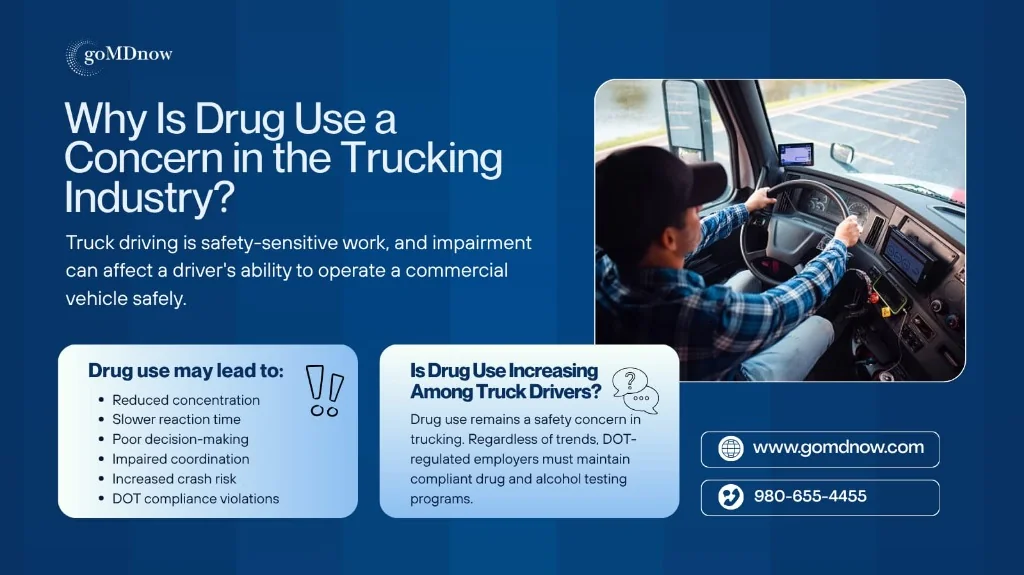
Why Is Drug Use a Concern in the Trucking Industry?
Truck drivers perform safety-sensitive work. A commercial vehicle can weigh tens of thousands of pounds and travel at highway speeds for extended periods. Any impairment that affects judgment, reaction time, coordination, or alertness can increase the risk of a serious crash.
Drug use may also contribute to:
- Reduced concentration
- Slower reaction time
- Poor decision-making
- Impaired coordination
- Increased accident risk
- Workplace safety concerns
- Regulatory violations
- Driver removal from safety-sensitive duties
For motor carriers, drug testing is therefore more than a compliance task. It is an important component of a broader DOT drug and alcohol testing program.
What Does DOT Drug Testing Cover?
FMCSA-regulated CDL drivers may be subject to several types of testing throughout their employment.
These include:
- Pre-employment testing
- Random drug and alcohol testing
- Reasonable suspicion testing
- Post-accident testing
- Return-to-duty testing
- Follow-up testing
FMCSA identifies these as key testing categories for covered drivers.
The purpose is not simply to catch drivers after substance use has occurred. A structured testing program can also act as a deterrent and help employers maintain a safer workplace. For a comprehensive overview, see our complete DOT drug testing guide.
Random Drug Testing Helps Detect Substance Use
Random testing is one of the most important tools available to motor carriers.
Unlike a scheduled test, a properly administered random test is unannounced. Drivers are selected from an appropriate testing pool throughout the year. This unpredictability makes it difficult for someone to time or avoid testing based on a known schedule.
FMCSA states that covered CDL drivers must be included in applicable random testing programs. Random selections must also be spread reasonably throughout the calendar year.
For an owner-operator who operates a CDL-required CMV and is not leased to another motor carrier, FMCSA requires participation in a consortium random testing pool.
Which Drugs Are Included in a DOT Drug Test?
A standard DOT drug test currently covers five drug classes:
- Marijuana
- Cocaine
- Opioids
- Amphetamines and methamphetamines
- Phencyclidine (PCP)
FMCSA states that DOT drug testing is performed through laboratory testing under 49 CFR Part 40.
It is important for drivers to understand that using a product marketed as legal or hemp-derived does not automatically eliminate the possibility of a drug-testing issue. Learn more about this in our article on common THC drug testing misconceptions. Employers and drivers should understand the applicable DOT rules rather than relying on product labels or assumptions.
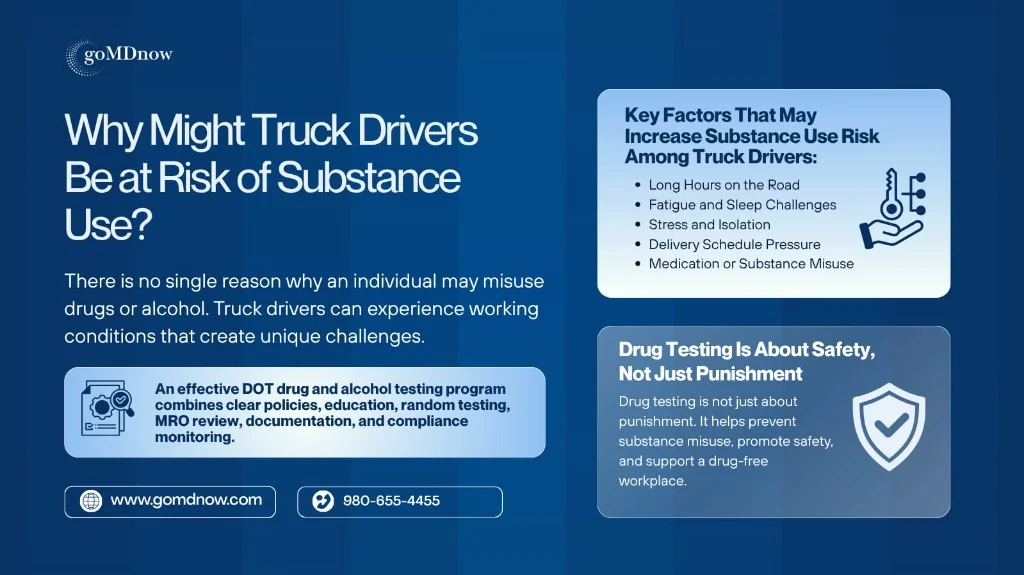
Why Might Truck Drivers Be at Risk of Substance Use?
There is no single reason why an individual may misuse drugs or alcohol. Truck drivers can experience working conditions that create unique challenges.
Long Hours on the Road
Extended periods behind the wheel can be physically and mentally demanding. Drivers may
spend days away from home and maintain irregular schedules.
Fatigue and Sleep Challenges
Long-distance transportation can involve changing schedules, nighttime driving, and
inconsistent sleep patterns. Some individuals may turn to substances in an attempt to
stay awake or manage fatigue, creating additional safety risks.
Stress and Isolation
Being away from family and normal social environments for extended periods can contribute
to stress or isolation for some drivers.
Pressure to Meet Delivery Schedules
Commercial transportation is highly schedule-driven. Pressure to complete routes on time
can create additional stress, particularly when drivers face traffic, weather, loading
delays, or other unexpected problems.
Misuse of Prescription or Other Substances
Substance misuse is not limited to illegal drugs. Certain medications can also affect
alertness, coordination, or the ability to safely perform safety-sensitive duties. Drivers
should discuss medication-related concerns with an appropriate medical professional and
understand their employer's policies.
Drug Testing Is About Safety, Not Just Punishment
A common misconception is that workplace drug testing exists only to punish employees. Drug testing is part of a larger safety system. SAMHSA describes workplace drug testing as a prevention and deterrence method that can be part of a comprehensive drug-free workplace program.
For trucking companies, an effective program should combine:
- Clear drug and alcohol policies
- Proper employee education
- Supervisor training
- Accurate testing procedures
- Random testing
- Proper documentation
- Medical Review Officer (MRO) review
- Compliance monitoring
- Appropriate action after violations
This approach helps employers address substance-use risks while maintaining regulatory compliance.
The FMCSA Drug and Alcohol Clearinghouse
The FMCSA Drug and Alcohol Clearinghouse is a secure online database that tracks drug and alcohol program violations for CDL drivers. Employers are required to query the Clearinghouse during pre-employment screening and to report violations when they occur.
As of November 18, 2024, a major rule change requires state driver licensing agencies to check the Clearinghouse and remove or deny CDL privileges for drivers who are in "prohibited" status due to unresolved drug or alcohol violations. This makes Clearinghouse compliance more critical than ever for both employers and drivers.
For more details about Clearinghouse violations, see our guide on DOT Clearinghouse violations explained.
What Happens If a Truck Driver Fails a DOT Drug Test?
A positive DOT drug test can have serious professional consequences.
According to FMCSA, a driver who fails a drug or alcohol test must be immediately removed from performing safety-sensitive functions. The driver cannot simply return to driving after the result. The applicable return-to-duty process must be completed with a DOT-qualified Substance Abuse Professional (SAP), followed by the required testing process.
Depending on the circumstances, the process may involve:
- Removal from safety-sensitive duties
- SAP evaluation
- Education or treatment recommendations
- Completion of the required SAP process
- Return-to-duty testing
- Follow-up testing
FMCSA states that follow-up testing is required after a driver completes the return-to-duty process and receives a negative return-to-duty test. The SAP determines the follow-up testing plan, with at least six directly observed tests required during the first 12 months.
The Importance of an Accurate DOT Testing Program
A trucking company should not wait until there is an accident or suspected impairment before taking drug and alcohol compliance seriously.
A strong program should be organized before problems occur.
Employers should ensure that:
- Covered drivers are correctly identified.
- Drivers are placed in the appropriate random testing pool.
- Random selections are conducted properly.
- Tests are ordered promptly after selection.
- Collection procedures follow DOT requirements.
- Results are reviewed by the appropriate MRO.
- Required records are maintained.
- Violations are handled according to FMCSA requirements.
FMCSA provides specific requirements for employers and drivers subject to its drug and alcohol testing program. Small fleet employers should pay particular attention to compliance, as they are often the most likely to face enforcement issues.
The Role of Trucking Companies
Motor carriers have an important responsibility in preventing impaired driving.
Companies can strengthen their safety culture by educating drivers about:
- DOT drug testing requirements
- Prohibited drug and alcohol use
- Random testing
- Prescription medication concerns
- Hemp, CBD, and marijuana-related risks — many drivers are confused about whether CBD or hemp products can cause a positive DOT test. The answer is yes, they can.
- Consequences of positive tests
- Return-to-duty requirements
- Driver responsibilities
Supervisors should also understand how to recognize potential signs of drug or alcohol misuse. FMCSA requires appropriate supervisor training for individuals responsible for making reasonable-suspicion determinations.
Why Compliance Matters for Owner-Operators
Owner-operators sometimes assume that drug and alcohol testing rules only apply to large trucking companies.
That is incorrect when the owner-operator operates a CDL-required commercial motor vehicle subject to FMCSA regulations.
FMCSA specifically states that owner-operators covered by the rules must participate in a DOT drug and alcohol testing program and enroll in a consortium random testing pool when applicable.
For independent drivers, using a qualified consortium/third-party administrator can help manage random selections, testing requirements, and compliance records. Learn more about goMDnow's consortium services.
How goMDnow Can Help
Managing a DOT drug and alcohol testing program can be challenging, particularly for owner-operators and small trucking companies. Many employers struggle with keeping up with changing regulations, managing random testing schedules, handling positive test results, and maintaining proper documentation — all while trying to run their business.
goMDnow provides drug and alcohol testing services designed to help employers and CDL drivers manage these important compliance requirements.
Services can include:
- DOT drug testing
- DOT alcohol testing
- Random testing consortium services
- Pre-employment testing
- Return-to-duty testing
- Follow-up testing
- MRO services
- Compliance documentation
- Clearinghouse-related services
With a structured testing program, trucking companies can better manage their responsibilities while supporting a safer workplace.
Building a Drug-Free Trucking Workplace: Final Thoughts
The trucking industry cannot rely on drug testing alone to eliminate substance misuse. Testing should be part of a broader workplace safety strategy.
Employers can support a drug-free workplace by providing clear policies, educating employees, training supervisors, maintaining confidential reporting processes, and ensuring drivers understand where to seek appropriate help.
Drivers also have an important responsibility. Operating a commercial vehicle while impaired can put their own lives and the lives of others at risk.
Concerns about drug use among truck drivers highlight why DOT drug testing and FMCSA compliance remain essential parts of commercial transportation safety. While claims that drug use is universally "on the rise" among truck drivers should be supported by reliable, current data, the potential consequences of substance use in a safety-sensitive occupation are clear. A single impaired driver can create significant risks for the driver, the carrier, and the public.
For trucking companies and owner-operators, maintaining a compliant DOT drug and alcohol testing program, participating in required random testing, and understanding the return-to-duty process are essential steps toward safer operations. With proper policies, testing, education, and compliance support, employers can create a stronger drug-free workplace while helping protect everyone who shares the road.
Need a DOT-compliant testing program? Contact goMDnow today for reliable drug and alcohol testing and compliance support.
Also Read: Top 6 Misconceptions About THC Drug Testing
Frequently Asked Questions
1. Is drug use increasing among truck drivers?
Drug use is an important safety concern in the trucking industry but claims of a broad
increase should be supported by current, reliable data. Regardless of trends, DOT-regulated
employers must maintain compliant
drug and alcohol testing programs.
2. Do truck drivers have to take random drug tests?
Yes. CDL drivers covered by FMCSA regulations are subject to
random testing requirements.
3. What drugs are tested in a DOT drug test?
DOT drug testing covers marijuana, cocaine, opioids, amphetamines/methamphetamines,
and PCP.
4. What happens after a positive DOT drug test?
The driver must be removed from safety-sensitive duties and complete the applicable
return-to-duty process
before resuming those duties.
5. Do owner-operators need a DOT drug testing program?
Yes. Covered owner-operators must participate in a DOT drug and alcohol testing program
and, when applicable, a
consortium random testing pool.