
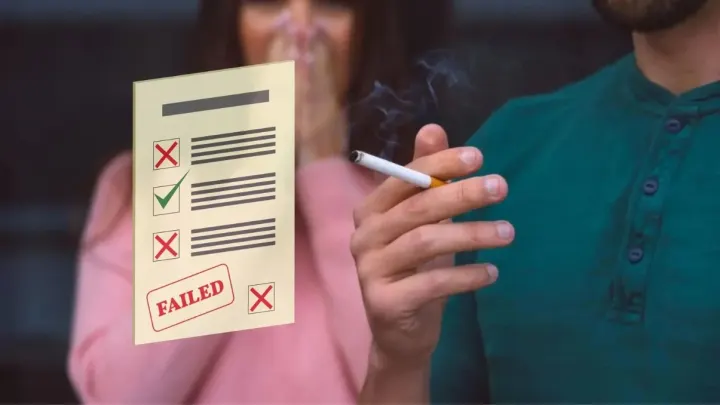
It is one of the most common questions in workplace drug testing and one that carries very different answers depending on whether you are asking about the science or the law. Can being around someone who is smoking marijuana cause you to fail a DOT drug test? The scientific answer is: under normal circumstances, almost certainly not. The legal answer for CDL drivers is: it does not matter, because the DOT will not accept secondhand smoke as a defense regardless.
This guide explains exactly what the research shows, when secondhand exposure could theoretically become a risk, and why DOT safety-sensitive employees need to understand both sides of this issue.
First: Tobacco Secondhand Smoke vs. Marijuana Secondhand Smoke
These are two very different situations that are often confused. Tobacco cigarette smoke does not contain THC the compound tested for in workplace drug panels. Exposure to cigarette secondhand smoke carries serious health risks, but it cannot cause a positive result on any standard workplace drug test.
Marijuana secondhand smoke is different. It does contain residual THC and other cannabinoids. The real question is whether the concentrations absorbed through passive inhalation are sufficient to reach the detection thresholds used in workplace drug testing. That is where the research becomes important.
What the Research Actually Shows
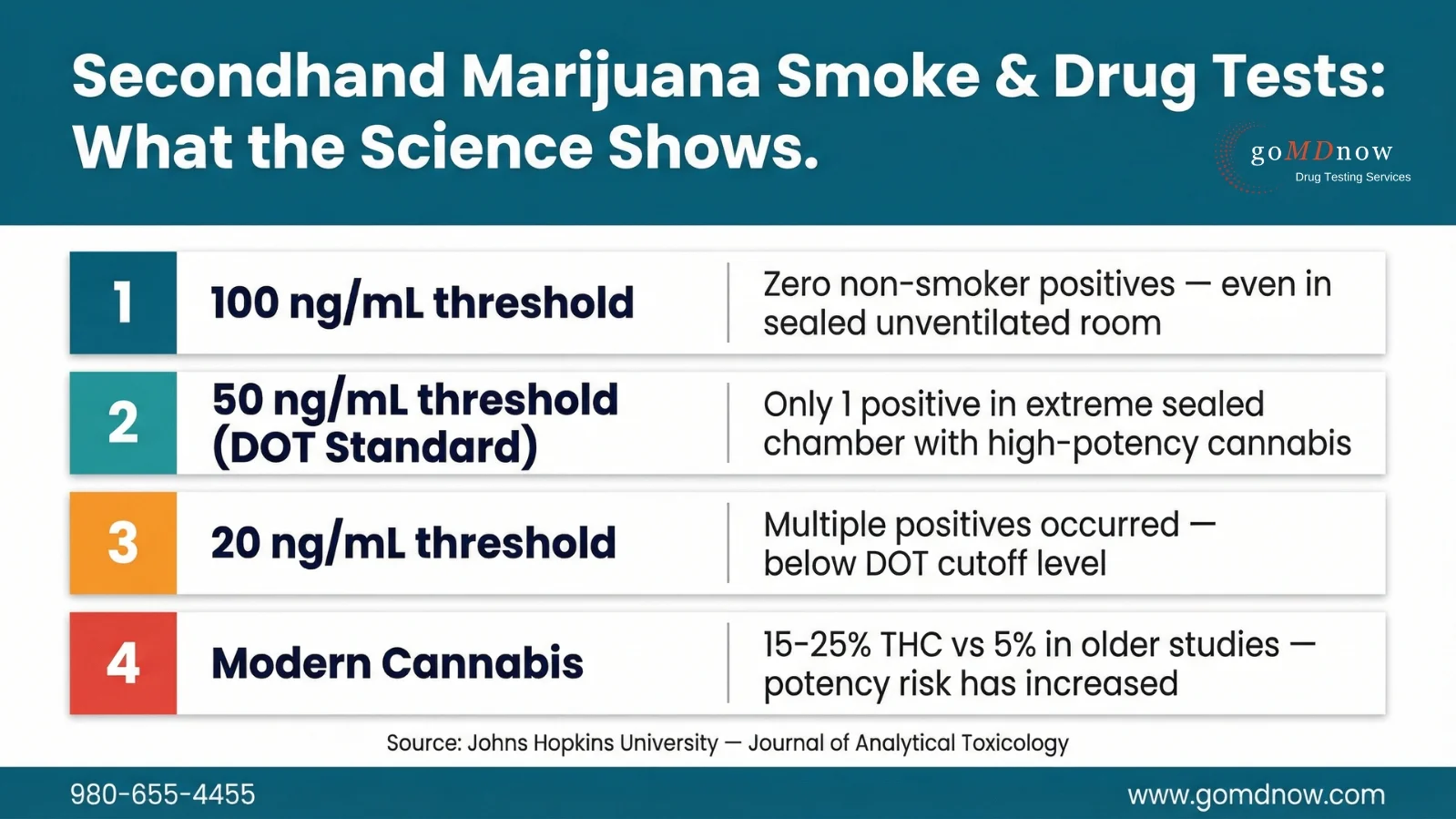
The most comprehensive and frequently cited study on this topic was published in the Journal of Analytical Toxicology and conducted by researchers at Johns Hopkins University in 2015. The study design placed non-smokers in a sealed, unventilated chamber with experienced cannabis users who smoked high-potency marijuana (up to 11.3% THC). Specimens from non-smoking participants were analyzed at multiple cutoff thresholds.
The results were highly instructive:
- At the 100 ng/mL threshold — zero non-smoker positives
- At the 75 ng/mL threshold — zero non-smoker positives
- At the 50 ng/mL threshold (the DOT initial screening standard) — only a single positive occurred, even in a sealed unventilated room with heavy smoke
- At a 20 ng/mL threshold — multiple positives occurred
- Maximum THC metabolite concentrations for non-smokers by GC-MS ranged from 1.3 to 57.5 ng/mL under extreme unventilated conditions
The key takeaway: for someone who does not smoke to fail a drug test due to secondhand smoke, they would need to be exposed to a high concentration of smoke in an unventilated space for a prolonged period. In well-ventilated real-world settings, the risk is extremely low. A separate study confirmed that non-smokers exposed to marijuana smoke in ventilated areas did not test positive for THC in urine tests.
An important caveat: cannabis potency has increased significantly over recent decades. Modern marijuana can test at 15–25% THC compared to 5–6% in earlier studies. Higher-potency cannabis means higher THC concentrations in secondhand smoke which is why older studies from the 1980s that suggested secondhand smoke was never a risk must be viewed in that context.
The "Hotboxing" Scenario: When Risk Increases
One real-world scenario deserves special attention for CDL drivers: being in a closed vehicle with passengers who are smoking marijuana sometimes called "hotboxing." In a sealed car or truck cab with windows closed, marijuana smoke concentrations can reach levels comparable to the extreme conditions in laboratory studies.
In a hotbox situation, smoke density is high and every inhalation contains marijuana smoke. It is possible to get high from secondhand cannabis smoke using this method. If THC absorption is high enough to produce psychoactive effects, the risk of a detectable urine concentration while still unlikely to reach the 50 ng/mL DOT cutoff increases meaningfully compared to outdoor or ventilated exposure.
The practical message for drivers: avoid enclosed spaces where marijuana is being smoked, and never allow passengers to smoke marijuana in your vehicle. This is not just about drug testing risk it is also about being impaired by a contact high while operating a commercial motor vehicle, which carries its own serious safety and legal implications.
Key Factors That Affect Secondhand THC Absorption
Several variables determine whether secondhand marijuana smoke exposure could affect a drug test result:
- Ventilation — the single most important factor. Well-ventilated spaces dramatically reduce ambient THC concentrations. Unventilated, enclosed spaces significantly increase absorption risk
- Duration of exposure — brief passing exposure carries negligible risk. Hours of sustained exposure in a closed environment is a different situation
- Proximity to the smoke source — sitting directly beside an active smoker vs. being across a room produces very different exposure levels
- Cannabis potency — high-THC modern strains produce denser, more concentrated secondhand smoke than lower-potency cannabis
- Individual metabolism — how quickly a person's body processes and eliminates THC metabolites affects detection windows. Learn more about how long marijuana stays in your system
- Type of drug test — urine testing (the DOT standard) has a 50 ng/mL initial cutoff that provides meaningful protection against low-level passive exposure. Hair and blood tests have different detection windows and sensitivities
The DOT Cutoff Thresholds and Why They Matter
The DOT drug testing program uses cutoff levels specifically designed to distinguish deliberate drug use from incidental trace exposure. For marijuana (THC metabolite):
- Initial immunoassay screen: 50 ng/mL
- GC-MS confirmatory test: 15 ng/mL
These thresholds exist precisely because researchers and regulators recognized that trace amounts of THC could be present from passive exposure. The 50 ng/mL initial cutoff is significantly higher than the trace levels typically produced by secondhand exposure in normal conditions. Learn about all standard DOT drug test cutoff levels across all five panel substances.
The Critical Point for CDL Drivers: Secondhand Smoke Is Not a Valid DOT Defense
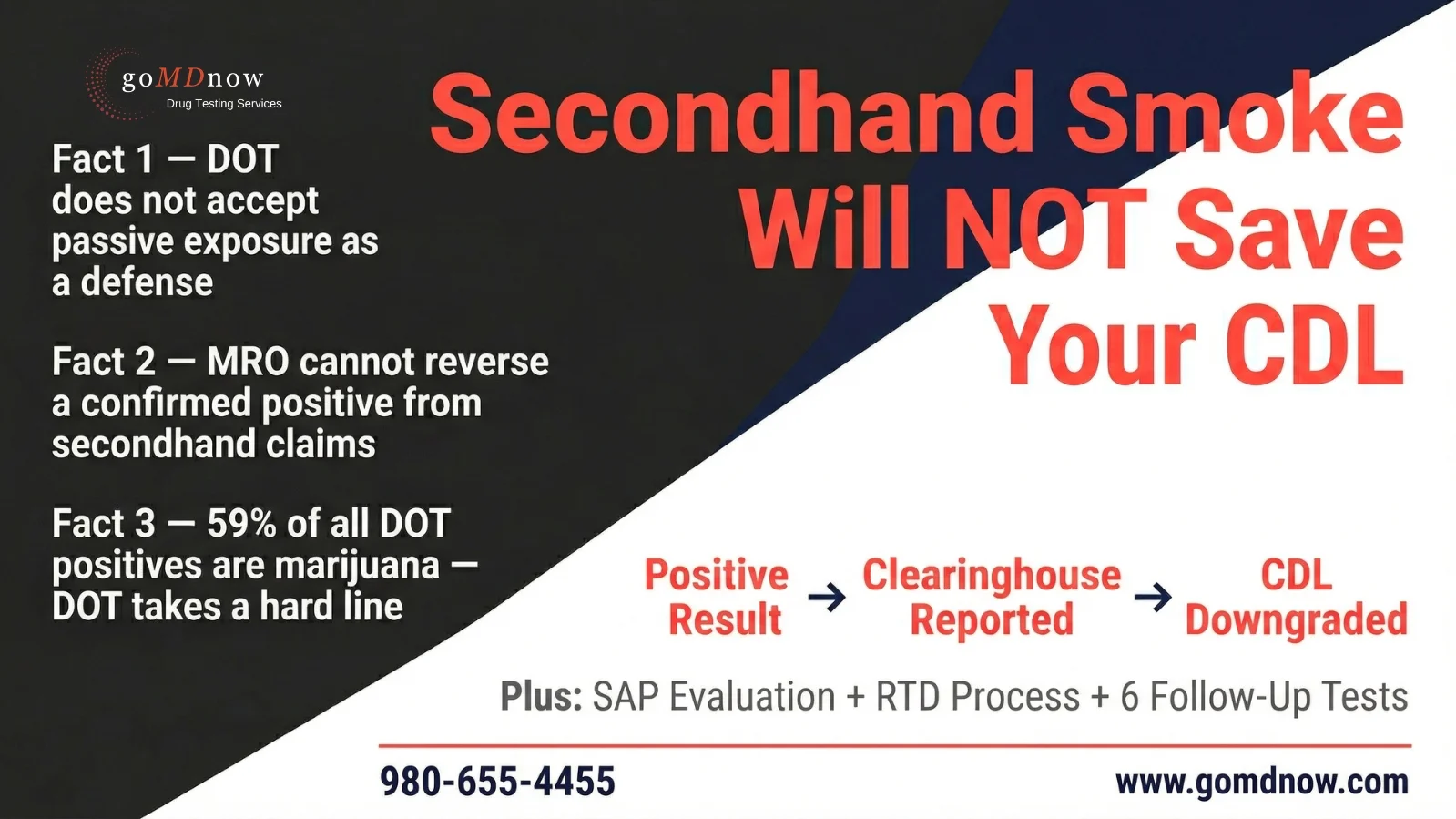
Even if secondhand smoke exposure could theoretically produce a positive result it will not save your CDL. This is the most important thing any driver or employer needs to understand.
The DOT does not accept secondhand marijuana smoke as a legitimate explanation for a confirmed positive test result. The Medical Review Officer (MRO) who reviews the result has no authority under 49 CFR Part 40 to verify a confirmed positive as negative based on a secondhand smoke claim. The result stands as a violation.
To put this in perspective: according to FMCSA Clearinghouse data through April 2025, positive drug tests account for 81% of all violations reported, and the marijuana metabolite represents 59% of all positive substances identified. In 2024 alone, 34,936 CDL holders tested positive for THC. The idea that a meaningful portion of these violations came from passive exposure rather than deliberate use is not credible and the DOT's position reflects that reality.
A confirmed positive marijuana result triggers immediate and serious consequences regardless of the claimed cause: removal from safety-sensitive duties, reporting to the FMCSA Drug and Alcohol Clearinghouse, potential CDL downgrade, mandatory SAP evaluation, and completion of the full Return-to-Duty process. See how Clearinghouse violations affect a CDL career long-term.
Practical Steps to Minimize Secondhand Smoke Exposure
While the science suggests the risk under normal conditions is low, CDL drivers and safety-sensitive employees should take sensible precautions:
- Avoid enclosed spaces where marijuana is being smoked — especially vehicles, small rooms, and poorly ventilated areas where smoke concentration can build
- Never allow marijuana smoking in your vehicle — both for drug test risk and contact high safety reasons
- Move to ventilated areas if you find yourself near marijuana smoke in a social or public setting. Outdoor exposure is far less likely to produce detectable THC levels
- Wash hands and change clothing after exposure to heavy smoke environments — THC can adsorb to skin and clothing as particles
- If you are tested after significant exposure, disclose the circumstances immediately to the MRO reviewing your result even though it will not reverse a confirmed positive, full transparency is always the right approach and you retain the right to a split-specimen retest within 72 hours of notification. Learn about other causes of unexpected positive drug test results
What Employers Should Know
Employers managing drug-free workplace programs should be prepared for employees to raise secondhand smoke claims after a positive result particularly as marijuana legalization expands and public exposure to cannabis smoke becomes more common in social settings, concerts, apartment buildings, and other shared spaces.
The appropriate response is clear and consistent: follow the MRO verification process, do not make independent determinations about secondhand exposure as a cause, and apply your drug and alcohol testing policy uniformly. For DOT-regulated employers, the federal framework does not provide exceptions for passive exposure. Non-DOT employers should ensure their policies also address this scenario explicitly to avoid discrimination claims or inconsistent enforcement.
Working with a qualified C/TPA or certified testing clinic ensures your MRO process, result reporting, and policy enforcement are defensible from a compliance standpoint.
Frequently Asked Questions (FAQs)
1. Can tobacco secondhand smoke cause a failed drug test?
No. Tobacco smoke does not contain THC or other substances tested for in standard workplace drug panels. Tobacco secondhand smoke carries serious health risks but cannot produce a positive result on any standard workplace drug test.
2. Can marijuana secondhand smoke cause a failed DOT drug test?
Under normal real-world conditions, it is highly unlikely. The DOT urine cutoff of 50 ng/mL is specifically set above the trace levels typically produced by passive exposure. The 2015 Johns Hopkins study found that even in a sealed unventilated chamber with high-potency cannabis, only a single positive occurred at the 50 ng/mL threshold.
3. Is secondhand smoke accepted as a defense for a positive DOT test?
No. The DOT does not accept secondhand marijuana smoke as a valid explanation for a confirmed positive result. The MRO cannot verify a confirmed positive as negative based on a passive exposure claim. The violation stands with full consequences.
4. Can hotboxing in a car cause a positive drug test?
It is more likely than ordinary outdoor exposure. In a sealed vehicle with windows closed and active marijuana smoking, THC concentrations can reach levels similar to extreme laboratory study conditions. While still unlikely to reach the 50 ng/mL DOT threshold in most cases, the risk is meaningfully higher than in ventilated settings and the contact high risk to a driving CDL holder is also a serious concern.
5. Does higher-potency modern cannabis change the secondhand smoke risk?
It increases it compared to older research. Modern cannabis can contain 15–25% THC vs. 5–6% in studies from prior decades. The 2015 Johns Hopkins study used 11.3% THC and found near-threshold results only in extreme sealed conditions. Higher-potency exposure in similar conditions could push results closer to or past the threshold.
6. What should a CDL driver do if they believe they tested positive from secondhand exposure?
Disclose all circumstances to the MRO immediately. Request a split-specimen GC-MS retest within 72 hours of MRO notification. Understand that secondhand smoke claims will not reverse a confirmed positive under DOT rules the best protection is avoidance of marijuana smoke environments in the first place.
7. What are the DOT cutoff levels for marijuana?
The initial immunoassay screen cutoff is 50 ng/mL. The GC-MS confirmatory test cutoff is 15 ng/mL. These thresholds are deliberately set above trace exposure levels. These thresholds apply consistently across all six DOT testing categories.
Final Thoughts
The science is reassuring: secondhand marijuana smoke is unlikely to cause a failed DOT drug test under normal ventilated conditions. The law is not: even if passive exposure did cause a positive result, it will not protect a CDL driver from the full consequences of a DOT violation. These two facts together define the practical reality for safety-sensitive employees the risk from secondhand smoke is low, but the stakes of any positive result are high enough that avoiding exposure entirely is the only sensible approach.
For employers, a clear drug-free workplace policy that addresses secondhand exposure scenarios, consistent MRO-backed testing procedures, and a compliant random testing program are the foundations of a defensible program. goMDnow provides full DOT and non-DOT drug testing programs with SAMHSA-certified laboratory processing and qualified MRO review on every test the infrastructure that makes policy enforcement consistent, legally defensible, and compliant. Explore our nationwide testing network or contact us to review your program.