
The Department of Transportation (DOT) requires drug and alcohol testing to help ensure the safety of commercial drivers and the public. Every employer regulated by the DOT must follow strict testing procedures outlined in 49 CFR Part 40 to remain compliant.
One situation that often raises questions is receiving a negative dilute urine drug test result. While the test is technically negative, a dilute sample may require additional review or even another collection depending on the laboratory's findings and DOT regulations.
In this DOT drug testing case study, we'll walk through a real-world scenario involving a commercial driver whose urine specimen tested negative but diluted, explain what the results mean, and outline the steps taken by the Medical Review Officer (MRO).
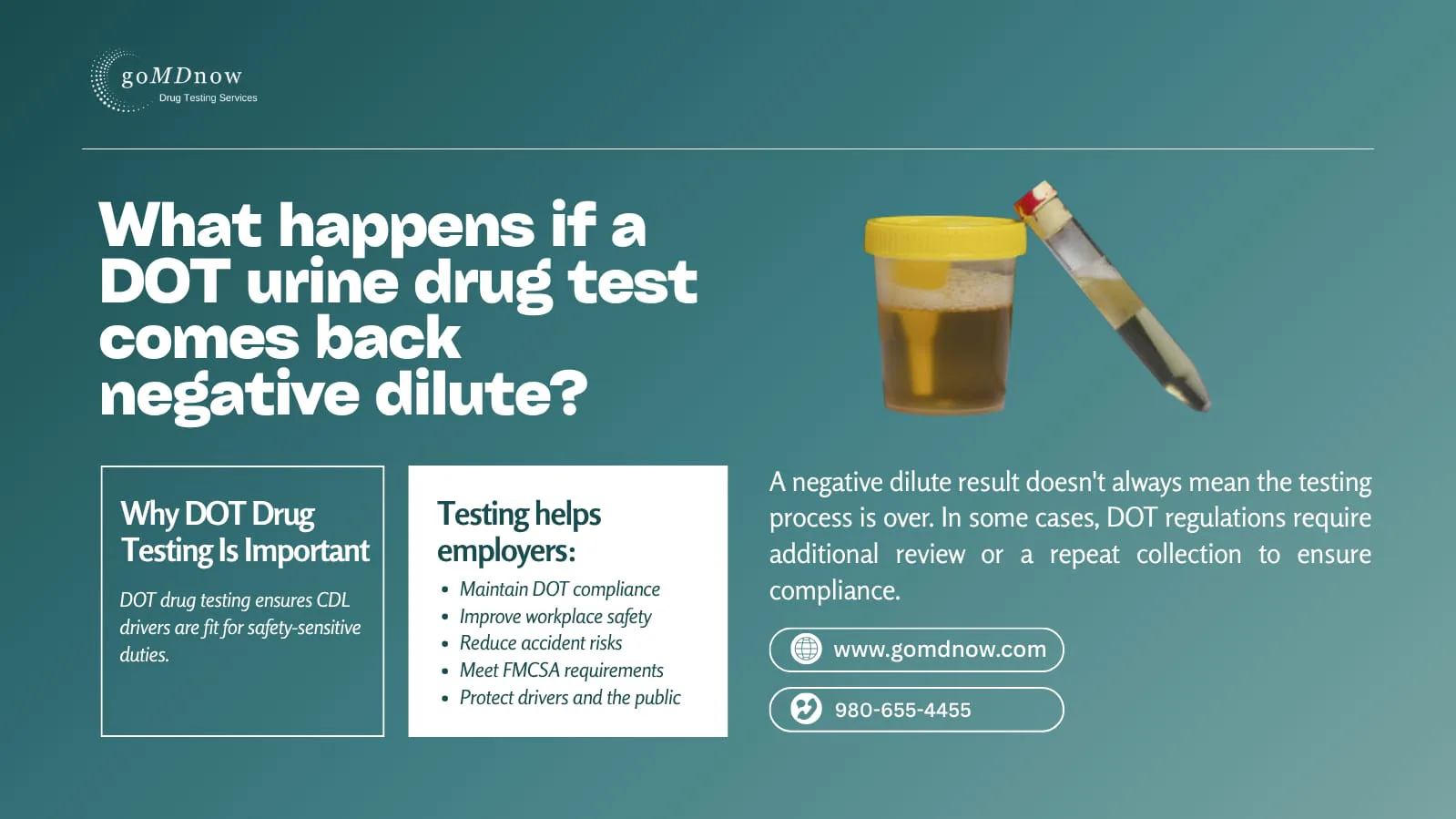
Why DOT Drug Testing Is Important
DOT drug testing is designed to ensure that safety-sensitive employees, including CDL drivers, are fit to perform their duties without the influence of prohibited substances.
Testing helps employers:
- Maintain DOT compliance
- Promote workplace safety
- Reduce accident risks
- Meet FMCSA regulations
- Protect employees and the public Whether the test is conducted for pre-employment, random selection, post-accident, reasonable suspicion, return-to-duty, or follow-up testing, every specimen must follow strict federal collection procedures.
Case Study: Negative Dilute DOT Urine Drug Test
Background
A commercial truck driver was randomly selected for a DOT urine drug test as part of the employer's federally required random testing program.
The employee visited a certified collection site, where the specimen was collected following DOT chain-of-custody procedures and sent to a DOT-approved laboratory for analysis.
Step 1: Laboratory Findings
- The laboratory reported the following results:
- Drug Test Result: Negative
- Specimen Status: Dilute
- Creatinine Level: 6.4 mg/dL
Although no prohibited drugs were detected, the urine specimen showed signs of dilution due to its low creatinine concentration.
What Does a Negative Dilute Result Mean?
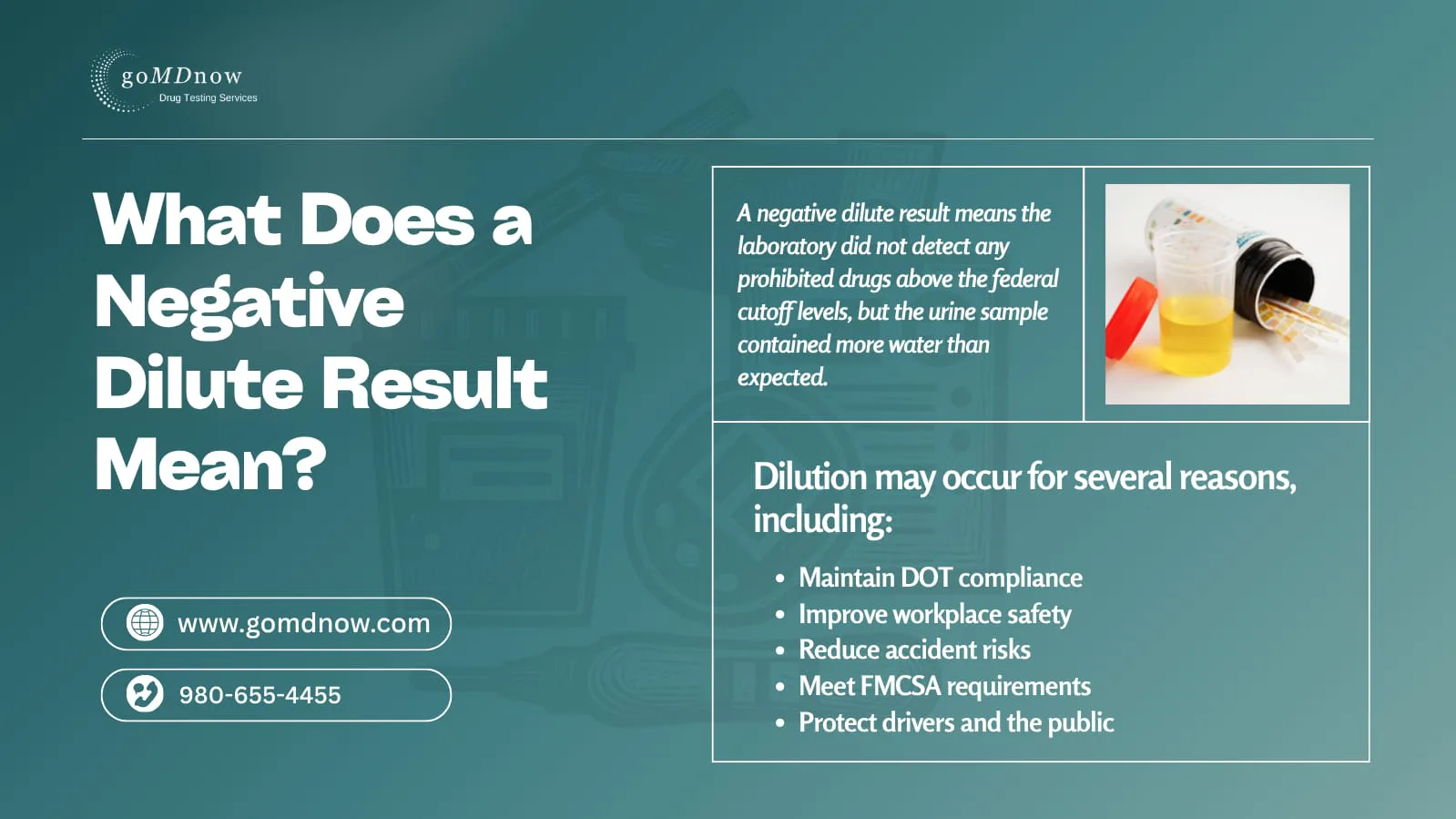
A negative dilute result means the laboratory did not detect any prohibited drugs above the federal cutoff levels, but the urine sample contained more water than expected. Understanding how hydration affects urine test accuracy helps explain why dilution may occur for several reasons, including:
- Drinking excessive amounts of water before testing
- Taking prescribed diuretic medications
- Certain medical conditions
- Unintentional overhydration
- Attempts to lower drug concentration in urine A dilute result does not automatically indicate drug use or cheating, but it requires careful evaluation under DOT procedures.
Step 2: Laboratory Report Sent to the Medical Review Officer (MRO)
After testing was completed, the certified laboratory electronically transmitted the results to the Medical Review Officer (MRO). The MRO is an independent licensed physician responsible for reviewing laboratory findings and ensuring that every DOT drug test is interpreted according to federal regulations.
Step 3: MRO Evaluation
Because the result was negative dilute, the employee was generally not required to be contacted immediately by the MRO. However, the employer was instructed to obtain another urine specimen as permitted under DOT regulations and company policy. The purpose of the second collection was to determine whether the dilution was an isolated occurrence or a repeated pattern.
Step 4: Second DOT Drug Test
The employee returned for another urine collection. The second laboratory report showed:
- Drug Test Result: Negative
- Specimen Status: Dilute
- Creatinine Level: 7.0 mg/dL Once again, prohibited drugs were not detected, but the specimen remained diluted.
Step 5: Medical Review Officer Investigation
Since two consecutive dilute specimens were received, the Medical Review Officer reviewed the situation more closely. The MRO may interview the employee to determine whether there is a legitimate medical explanation for repeated dilution. During the review, the MRO may ask about:
- Prescription medications, including diuretics
- Recent medical treatment
- Hydration habits
- Water consumption before testing
- Any medical condition that could affect urine concentration
The purpose is to determine whether the dilution occurred naturally or requires additional testing.
Possible Outcomes
Scenario 1: Legitimate Medical Explanation
If the employee is taking prescribed diuretic medication or has another valid medical reason for producing dilute urine, the MRO may verify the explanation. In this situation, the result is typically reported as negative, and no further testing may be necessary.
Scenario 2: Excessive Water Consumption
If no medical explanation exists and the employee simply consumed excessive water before testing, the MRO or employer may require another DOT of urine drug test. The employee is instructed to avoid drinking unusually large amounts of water before the next collection while still remaining normally hydrated.
Step 6: Third DOT Drug Test
A third urine specimen was collected under proper DOT collection procedures. Laboratory findings:
- Drug Test Result: Negative
- Specimen Status: Normal The urine sample was no longer diluted and met all DOT testing requirements.
Final MRO Decision
After reviewing the laboratory findings and confirming that the third specimen was valid, the Medical Review Officer reported the result to the employer as:
Verified Negative
The employee successfully completed the DOT drug testing process and remained eligible to perform safety-sensitive duties.
Understanding Creatinine Levels
Creatinine is a naturally occurring waste product found in the urine. Laboratories measure creatinine concentration to determine whether a urine specimen is unusually diluted. According to DOT regulations:
- Higher creatinine levels generally indicate a normal urine specimen.
- Low creatinine levels may indicate dilution.
- When a negative dilute specimen has a creatinine concentration between 2.0 and
5.0 mg/dL, 49 CFR Part 40 requires immediate recollection under direct observation. This requirement helps preserve the integrity of the DOT drug testing program while ensuring fair and consistent testing procedures.
Key Takeaways from This Case Study
- This case demonstrates several important points:
- A negative dilute result does not mean the employee failed the drug test.
- Dilute urine may occur for legitimate medical or hydration-related reasons.
- The Medical Review Officer carefully evaluates each case before reporting final results.
- Repeat collections may be required depending on laboratory findings and DOT regulations.
- Employers should always follow DOT procedures to maintain compliance.
How Employers Can Stay DOT Compliant
Managing DOT drug testing can be complex, especially when handling repeat collections, MRO reviews, and federal reporting requirements.
Working with an experienced DOT drug testing provider helps employers:
- Schedule DOT urine drug tests nationwide
- Access DOT-approved laboratories
- Receive Medical Review Officer (MRO) services
- Manage random drug testing programs
- Track compliance records
- Simplify FMCSA requirements Using a trusted compliance partner reduces administrative burdens while helping
employers remain compliant with federal regulations.
Conclusion
Negative dilute urine drug test results can create confusion for both employers and commercial drivers. Knowing how to interpret drug test results helps clarify that they do not automatically indicate drug use or misconduct. By following DOT regulations, conducting repeat collections when necessary, and relying on Medical Review Officer evaluations, employers can ensure accurate, fair, and legally compliant drug testing. Understanding the DOT drug testing process helps transportation companies maintain compliance, protect public safety, and support a drug-free workplace.
Frequently Asked Questions (FAQs)
1. What is a negative dilute urine drug test?
A negative dilute urine drug test means no prohibited drugs were detected, but the urine sample contained more water than normal, resulting in a lower concentration. 2. Does a negative dilute result mean the driver failed the test? No. A negative dilute result is still considered a negative drug test, although additional testing may be required.
3. Why does urine become diluted?
Dilution can result from excessive water intake, prescribed diuretics, medical conditions, or other legitimate factors.
4. What does the Medical Review Officer (MRO) do?
The MRO reviews laboratory results, investigates potential medical explanations, and reports verified results to the employer.
5. Will the employee need another drug test after a negative dilute result?
Depending on DOT regulations, employer policy, and the creatinine level, another specimen may be required.
6. What happens if multiple dilute specimens are collected?
The MRO may interview the employee and determine whether another collection or additional review is necessary.
7. What is creatinine in a DOT urine drug test?
Creatinine is a natural substance measured in urine to determine whether the specimen has been diluted.
8. How can employers simplify DOT drug testing compliance?
Employers can partner with goMDnow for DOT drug testing, MRO services, random consortium management, nationwide collections, and compliance support.
For help selecting or scheduling a compliant test, review testing options and rates or contact goMDnow.